Standing water in your dishwasher? Here's what's normal, what isn't, and how to fix it — clogged filter, garbage disposal knockout plug, drain hose, air gap, and pump — for Tampa homes.
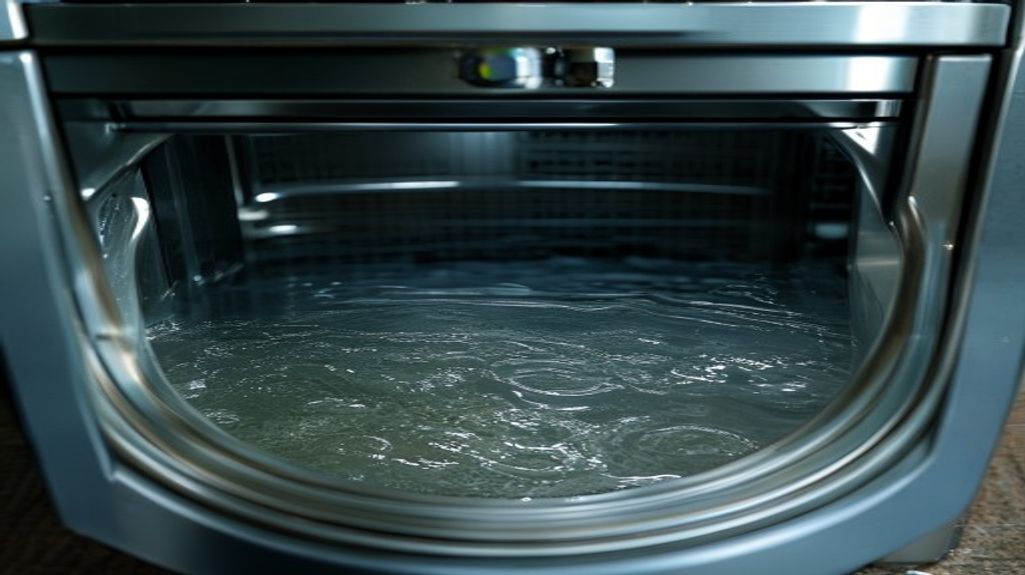
Opening the dishwasher to find a pool of dirty water in the bottom is one of the most common kitchen calls we get in Tampa. The good news: most of the time it's a simple drainage clog you can clear yourself in about 20 minutes, with no plumber and no parts. The trick is checking the causes in the right order — from easiest to hardest — so you find it fast.
First, a quick reassurance: a small amount of water (about a cup, sitting in the filter area at the very bottom) is completely normal. It's there by design to keep the seals from drying out. The problem is when you've got standing water — an inch or more covering the bottom that doesn't drain. That means water is going in but not coming out. Here's how to fix it.
Before You Start
- Run the cycle once more, then cancel/drain. Many dishwashers have a 'Cancel & Drain' button or you can start a cycle and cancel it — sometimes it just didn't finish draining.
- If water remains, scoop it out. Bail out the standing water with a cup and soak up the rest with towels so you can work. Tip: lay towels under the unit too, in case there's a leak.
- Safety first. For anything beyond cleaning the filter, switch the dishwasher off at the breaker before reaching near the pump or wiring.
Cause #1: A Clogged Filter (Start Here)
The filter at the bottom of the tub catches food debris, and when it clogs, water can't drain through it. This is the single most common cause — and in Tampa, our hard water makes it worse, because mineral scale builds up on the filter and screen alongside the food gunk.
- Remove the bottom rack and locate the cylindrical or flat filter in the floor of the tub (usually twists out — check your manual).
- Rinse it under hot water and scrub with a soft brush to clear food, grease, and mineral buildup. An old toothbrush works great.
- Wipe out the filter housing and clear any debris from the screen underneath.
- Reinstall, run a short cycle, and see if it drains. Make this a monthly habit in Tampa — hard water clogs filters faster here than in soft-water regions.
Cause #2: The Garbage Disposal Connection (the One People Miss)
Your dishwasher almost always drains through the garbage disposal under the sink, so a disposal problem becomes a dishwasher problem. There are two issues to check here — and the second is the one that stumps most homeowners:
Run the disposal
If the disposal is clogged or full, the dishwasher has nowhere to drain. Run the disposal with the water on for 15–20 seconds, then try draining the dishwasher again. Simple, and surprisingly often the whole fix.
Check the knockout plug (especially after a NEW disposal install)
This is the big one. When a new garbage disposal is installed, there's a 'knockout plug' inside the disposal's dishwasher inlet that MUST be removed for the dishwasher to drain into it. If a disposal was recently replaced and the dishwasher suddenly won't drain, there's a very good chance the plug was never knocked out — so the dishwasher water has nowhere to go. It's a five-minute fix once you know to look, and it's one of the most common reasons a dishwasher 'suddenly' stops draining in Tampa kitchens.
Recently had a disposal replaced — or need one done right (with the dishwasher line opened up)? Here's our service: Garbage Disposal Replacement in Tampa
Cause #3: A Kinked or Clogged Drain Hose
The drain hose runs from the dishwasher to the disposal or sink drain. If it's kinked, pinched behind the unit, or clogged with debris and grease, water can't get through.
- Look under the sink and behind/beneath the dishwasher for an obvious kink or pinch — sometimes a stored item under the sink is simply crushing the hose.
- Check the high loop. The drain hose should loop up high under the counter before going down to the drain — this prevents dirty sink water from siphoning back into the dishwasher. A missing or sagging high loop causes drainage and backflow problems.
- For a clog, disconnect the hose ends (have a bucket and towels ready), and flush it out or clear it with a plumber's snake.
Cause #4: A Clogged Air Gap
If your sink has a small chrome cylinder on top (next to the faucet), that's the air gap — and it can clog with debris, causing water to back up into the dishwasher (you might also see water bubbling up at the air gap during a cycle).
- Twist off the air gap cap and cover, and pull out the inner piece.
- Clean out any food debris and mineral buildup with a brush and hot water.
- Reassemble and test. Not every Tampa kitchen has an air gap — if yours doesn't, skip this step.
Cause #5: A Stuck Check Valve or Failed Drain Pump
If you've cleared the filter, disposal, hose, and air gap and water still won't drain, the problem is deeper in the machine:
- Check valve: a small flap that lets water out but not back in. If it sticks, drainage stops. It's usually near the pump and sometimes cleanable.
- Drain pump: the pump that pushes water out can jam with a piece of glass, a fruit pit, or debris — or simply fail. You may hear a humming or grinding with no drainage. Clearing a jam is a moderate DIY job; a failed pump usually needs replacement.
- This is the point where most homeowners are better off calling a pro — accessing the pump means pulling the unit and working around water and wiring.
The Tampa Hard-Water Factor
Tampa Bay has notably hard water, and it quietly makes dishwasher drainage problems more frequent. Mineral scale builds up on the filter, inside the drain hose, and on the pump over time, narrowing passages and trapping food debris. A few habits help:
- Clean the filter monthly (more often than the manual says — our water demands it).
- Run a dishwasher cleaner or a cup of white vinegar on an empty hot cycle monthly to dissolve scale.
- Scrape plates well before loading — less food debris means less to clog the filter and pump.
- If you have a water softener, keep it maintained; it protects the dishwasher along with the rest of your plumbing.
When to Call a Tampa Handyman or Plumber
Work through causes 1–4 yourself — they're genuinely DIY. Call a pro when:
- You've cleared the filter, disposal, hose, and air gap and it still won't drain (likely the pump or check valve).
- There's water leaking onto the floor or under the cabinet — that needs prompt attention before it damages cabinets and subfloor.
- A recently installed disposal is involved and you're not comfortable checking the knockout plug yourself.
- You smell a musty or sewage odor, which can point to a drain or backflow issue beyond the dishwasher.
A typical dishwasher-drainage diagnosis and fix in Tampa runs $90–$200 for clog clearing, hose, or air-gap work; a drain pump replacement is more depending on the part. Often we can clear it on the first visit — and check the disposal and drain line while we're there.
Standing water, slow drains, and leaks are bread-and-butter for us. See what our plumbing & fixture service covers: Plumbing & Fixture Services in Tampa
Another common Tampa plumbing mystery, solved: Why Is My Toilet Leaking From the Bottom?
Frequently asked questions
- Is it normal to have water in the bottom of my dishwasher?
- A small amount — about a cup, sitting in the filter area at the very bottom — is completely normal and there by design to keep the seals from drying out. What's not normal is standing water (an inch or more covering the bottom) that doesn't drain, which means a clog or pump problem.
- Why won't my dishwasher drain all of a sudden?
- The most common causes are a clogged filter, a full or clogged garbage disposal, or a kinked/clogged drain hose. If it happened right after a new garbage disposal was installed, the likely cause is a knockout plug that was never removed from the disposal's dishwasher inlet — a quick fix once you know to check it.
- Can a garbage disposal stop a dishwasher from draining?
- Yes. The dishwasher usually drains through the disposal, so a clogged or full disposal blocks it — run the disposal and try again. And if the disposal was recently replaced, the knockout plug inside its dishwasher inlet must be removed; if it wasn't, the dishwasher water has nowhere to go.
- How do I clean a dishwasher filter?
- Remove the bottom rack, twist out the filter at the floor of the tub, rinse it under hot water, and scrub off food and mineral buildup with a soft brush. Wipe the housing and clear the screen underneath, then reinstall. In Tampa's hard water, doing this monthly prevents most drainage problems.
- Does Fenelon Handyman fix dishwashers that won't drain in Tampa?
- Yes — clearing dishwasher drain clogs, fixing drain hoses and air gaps, replacing garbage disposals (with the dishwasher line opened correctly), and addressing leaks are routine for us across Tampa Bay. We diagnose the real cause and often fix it on the first visit. Call or text (786) 509-5555.
Dishwasher full of water that won't drain — or leaking under the cabinet? Call or text (786) 509-5555 for a fast, insured Tampa handyman. See our plumbing & fixture services.
General Repairs in Tampa, FL
Done-for-you by an insured local crew — free quotes, same-week scheduling.
Need a hand with this in Tampa?
Get a free quote from a 4.8★ local crew. We answer fast and show up on time.
We handle this kind of work across Tampa Bay — including handyman service in Temple Terrace, handyman service in University, handyman service in Carrollwood and handyman service in Brandon. See all service areas.