How to use a stud finder the right way — every type explained, step-by-step instructions, how to find a stud without one, and why Tampa's concrete-block homes change everything about mounting.
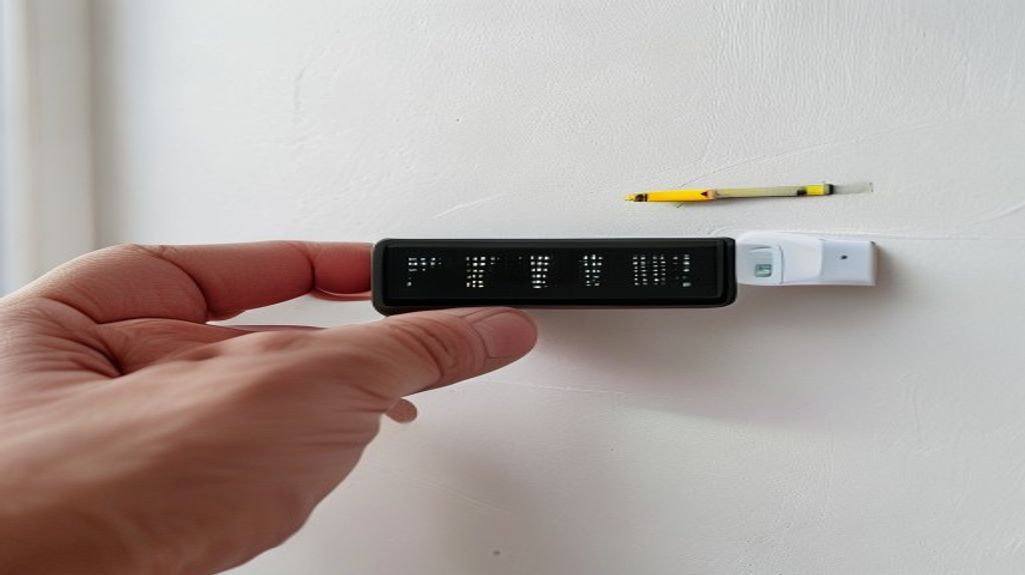
Hanging a TV, a heavy mirror, floating shelves, an upper cabinet, or a bathroom grab bar all have one thing in common: if you anchor them into drywall alone, they will eventually pull out — sometimes taking a chunk of wall with them. The fix is simple in principle: find the wall stud (the vertical wood or metal framing member behind the drywall) and screw into that instead. A stud finder is the tool that makes this fast and reliable.
But there's a Tampa-specific wrinkle most national guides skip entirely: a large share of Florida homes are built with concrete block, not wood framing. On those walls a stud finder won't help you, and the whole anchoring strategy changes. We'll cover both. Here's everything you need to use a stud finder correctly — and how to know when there's no stud to find at all.
What a Stud Finder Actually Does
Inside a typical drywall wall, the wall surface is screwed to vertical framing members called studs, spaced at regular intervals. The drywall between studs is hollow — usually just a half-inch of gypsum with air behind it. A wall anchor in that hollow section can only hold so much before it tears out. Screwing directly into a stud gives you solid wood (or metal) to bite into, which is dramatically stronger.
A stud finder locates those framing members without you cutting into the wall. There are two fundamentally different ways it can do that, which is why choosing the right type matters.
- Magnetic stud finders detect the metal screws or nails that fasten the drywall to the studs. They have no batteries and never need calibration — you slide them along the wall until a magnet snaps to a hidden fastener.
- Electronic stud finders detect the change in density behind the drywall. The wall is less dense over a hollow cavity and more dense over a solid stud; the sensor reads that difference and lights up or beeps when it crosses a stud edge.
Why Tampa Walls Are Different: Wood Frame vs. Concrete Block
This is the single most important thing to understand before you start, and it's where Tampa homes diverge from the rest of the country. Florida builds for heat, humidity, termites, and hurricanes — and that means a lot of concrete block (CMU) construction.
- Interior walls in almost all Tampa homes are wood-framed (or sometimes metal-framed) drywall. A stud finder works normally on these — bedroom-to-hallway walls, walls between rooms, and most non-load-bearing partitions.
- Exterior walls and the perimeter of the home are very often concrete block in Tampa Bay, especially in homes built from the 1960s onward. The block is usually furred out with thin strips and covered in drywall, or has drywall adhered directly. There are no studs at regular spacing — behind that drywall is solid concrete.
- A stud finder on a block exterior wall will either read 'solid' everywhere or give erratic results, because it's sensing the dense block rather than a framing member. That's your signal to switch from a stud-mount strategy to masonry anchors.
Quick field test: knock on the wall. A wood-framed drywall wall sounds hollow between studs and solid where you hit one. A block wall covered in drywall sounds dull and solid almost everywhere, with very little hollow ring. If the whole wall sounds solid, you're likely on block — skip ahead to the concrete-block section below.
The Types of Stud Finders, and Which to Buy
If you're buying one tool for general home use in Tampa, an electronic edge-finder or a center-finding model is the best value. Here's how the options compare:
Magnetic stud finders
Inexpensive, pocket-sized, and foolproof — no batteries, nothing to calibrate. The trade-off is that they only find the fastener, not the full stud, so you have to find two or three fasteners to confirm the stud line. Great as a backup or for confirming an electronic reading.
Electronic edge-finders
The classic stud finder. You calibrate it on a hollow section, slide it along the wall, and it signals when it reaches the left and right edges of a stud. The center is the midpoint between those two edges. Affordable and accurate once you learn to use it.
Center-finding (instant) stud finders
Use multiple sensors to identify the center of the stud directly, often without the slow calibration step. Faster and more beginner-friendly — a good pick if you mount things regularly.
Deep-scan and wall-imaging finders
Higher-end units scan deeper (useful through thick or double-layer drywall) and the best 'wall scanners' can distinguish wood, metal, and live electrical wiring, even rendering a rough image of what's behind the surface. Worth it for renovation work or if you want to avoid drilling into a wire or pipe.
Phone-app 'stud finders'
Apps that use your phone's magnetometer work like a basic magnetic finder — they detect screws and nails, not density. They're fine in a pinch but noticeably less reliable than a dedicated tool. Don't trust one for a heavy TV mount.
How to Use an Electronic Stud Finder, Step by Step
The process below works for virtually every electronic model. Read your tool's manual for the specific button layout, but the technique is the same:
- 1. Start on a hollow spot. Place the finder flat against the wall where you're confident there's no stud (away from corners, outlets, and trim). Hold it flush — tilting it throws off the reading.
- 2. Calibrate. Press and hold the button; the tool sets its baseline against the hollow wall. Wait for the ready light or beep before moving.
- 3. Slide slowly and level. Move the finder horizontally in a straight line, keeping firm, even contact. Go slow — moving too fast is the number-one cause of missed or false readings.
- 4. Mark the first edge. When it signals, you've hit the left edge of a stud. Mark it with a pencil.
- 5. Find the other edge. Continue past the stud, then approach from the other side to find the right edge and mark it. A standard wood stud is about 1.5 inches wide — your two marks should be roughly that far apart.
- 6. Mark the center. The center of the stud is the midpoint between your two edge marks. That's your drilling point.
- 7. Confirm. Move up or down a few inches and re-scan, or use a magnetic finder to confirm a screw on that line. Studs run vertically, so a true stud will read at the same horizontal position higher and lower on the wall.
Mounting a TV is the most common reason Tampa homeowners hunt for studs. See our complete walkthrough — including mounting on block walls: TV Mounting in Tampa: The Complete Homeowner's Guide
How to Find a Stud Without a Stud Finder
No tool handy? Studs follow predictable rules, so you can locate them with a little detective work:
- Use standard spacing. Studs are typically 16 inches apart, center to center (sometimes 24 inches in newer or some block-furred construction). Find one stud and you can measure over 16 inches to find the next.
- Start at a corner. Walls almost always have a stud in the corner. Measure out 16 inches from the corner as your first guess.
- Check electrical boxes. Outlets and light switches are screwed to the side of a stud. Tap gently beside the box — the stud is usually on one side. (Never probe inside the box.)
- Look at the trim. Baseboard and crown molding are nailed into studs. A close look in raking light, or tiny filled nail holes, can reveal the stud line.
- Knock and listen. Tap along the wall — a hollow sound means cavity, a solid thud means stud. With practice this alone gets you close.
- Confirm before you drill. Whatever method you use, verify with a second method or a small finishing nail in an inconspicuous spot before committing to a big hole.
What You Should Always Anchor Into a Stud
Not every picture frame needs a stud — but anything with real weight or leverage does. In a Tampa home, anchor these into studs (or into block with proper masonry anchors):
- TV wall mounts — especially 55-inch and larger, and any full-motion arm that adds leverage
- Floating shelves carrying books, dishes, or decor
- Upper kitchen cabinets and any wall cabinet
- Heavy mirrors and large framed art (roughly 15+ pounds)
- Bathroom grab bars — these must hit solid framing or rated heavy-duty anchors; a grab bar that pulls out is a serious injury risk
- Closet systems, garage shelving, and wall-mounted organizers
- Curtain rods on wide windows, and any rod that will carry heavy drapes
- Wall-mounted handrails on stairs
Floating shelves and upper cabinets are a frequent Tampa request — and a common DIY pull-out. Here's how we handle carpentry and cabinet work: Trim & Finish Carpentry in Tampa
When There's No Stud: Mounting on Concrete Block in Florida
If your knock test came back solid and the stud finder reads dense everywhere, you're on a concrete-block wall — extremely common on the exterior walls of Tampa homes. The good news: block is actually stronger than wood. You just anchor differently.
- Use masonry anchors, not drywall anchors. Tapcon concrete screws, sleeve anchors, or wedge anchors are designed to bite into block or concrete. A standard plastic drywall anchor will do nothing in block.
- Drill with a masonry bit and hammer drill. Block and concrete require a carbide masonry bit; a hammer drill makes the job far easier and gives a clean, correctly sized hole.
- Drill into the solid web, not the hollow cell, when possible. Concrete block has hollow cores. For heavy loads, hitting the solid part of the block (or filling the cavity with an appropriate anchor) holds best.
- Mind the furring gap. If the block is furred out with strips and drywall, there may be a 3/4-inch air gap behind the drywall before you reach block — use anchors and screws long enough to pass through and still get full embedment into the block.
- Don't over-torque. Tapcons can strip out if overtightened in block. Snug is strong; cranking is how you lose the hole.
Mounting a heavy TV or cabinet on block is well within DIY range with the right bit and anchors, but it's unforgiving of mistakes — a stripped hole or a crack in a visible exterior wall is hard to undo. This is one of the most common reasons Tampa homeowners call us for what looks like a simple mount.
Common Stud-Finding Mistakes
- Moving the finder too fast. Slow, steady passes are the difference between accurate and useless readings.
- Calibrating over a stud. If you happen to start on a stud, the tool baselines wrong and reads the whole wall incorrectly. Start on a clearly hollow spot.
- Trusting a single reading. Always confirm the stud line at a second height before drilling.
- Ignoring what's inside the wall. Studs often have electrical wires running beside them and plumbing in wet walls. Use a finder with AC/wire detection near kitchens, baths, and outlets, and never drill blindly deep.
- Forgetting Tampa's block walls. Burning ten minutes hunting for a 'stud' that doesn't exist on an exterior block wall is the most common Florida-specific mistake.
- Using drywall anchors as a shortcut for heavy items. They feel solid going in and fail under load weeks later. Find the stud, or use a properly rated anchor.
When to Do It Yourself vs. Call a Tampa Handyman
Finding a stud and hanging a light shelf is a satisfying DIY job. It makes sense to call a pro when the stakes or the surface raise the difficulty:
- DIY-friendly: locating studs, hanging shelves and lighter art, mounting curtain rods, assembling and wall-anchoring furniture on standard interior drywall.
- Worth a pro: large or full-motion TV mounts, upper cabinets, grab bars where a failure means injury, and anything on a concrete-block wall where you don't have a hammer drill and masonry anchors.
- Definitely a pro: mounts where wiring needs to be concealed in the wall, or where you suspect plumbing or electrical directly behind the mounting location.
For reference, a typical Tampa handyman visit to mount a TV or hang cabinets runs $120–$300 depending on the size, the wall type, and whether cables are concealed — and includes finding the framing correctly the first time, on drywall or block.
See exactly what's included in a professional TV mount in Tampa, and what it costs: TV Mounting Cost in Tampa (2025 Pricing Guide)
Frequently asked questions
- How far apart are studs in a Tampa home?
- On wood-framed interior walls, studs are typically 16 inches apart center to center, and sometimes 24 inches in newer construction or where block walls are furred out. Find one reliable stud and you can measure 16 inches to locate the next. Always confirm with the tool rather than assuming, since spacing can vary around windows, doors, and corners.
- Why does my stud finder say the whole wall is solid?
- That almost always means you're scanning a concrete-block wall, which is very common on the exterior walls of Tampa homes. There are no wood studs behind it — it's solid block covered in drywall. Switch to masonry anchors (like Tapcon screws) and a hammer drill with a masonry bit instead of trying to find a stud.
- Can I just use drywall anchors instead of finding a stud?
- For light items, rated drywall anchors are fine. For anything heavy — TVs, cabinets, grab bars, large mirrors — anchor into a stud or into block with a masonry anchor. Drywall anchors feel secure when installed but commonly fail under sustained weight, sometimes weeks or months later, taking part of the wall with them.
- Do phone stud finder apps actually work?
- Phone apps use your device's magnetometer to detect the metal screws holding drywall to studs, similar to a basic magnetic finder. They can work for finding a fastener in a pinch, but they're less reliable than a dedicated tool and won't sense density. For a heavy or expensive mount, use a real stud finder.
- Is it safe to mount a heavy TV on a Florida concrete-block wall?
- Yes — block is actually stronger than wood framing when you anchor correctly. You'll need a hammer drill, a carbide masonry bit, and proper masonry anchors (Tapcons, sleeve, or wedge anchors) rather than drywall anchors. Because a stripped hole or a crack in a visible wall is hard to fix, many Tampa homeowners have us handle block-wall mounts.
- Can Fenelon Handyman Services mount my TV, shelves, or cabinets?
- Yes — TV mounting, floating shelves, cabinet hanging, grab bars, and furniture anchoring are some of our most requested jobs across Tampa Bay, on both drywall and concrete block. We find the framing correctly the first time and use the right anchor for your wall type. Call or text (786) 509-5555 for same-week scheduling.
Need something mounted right the first time — on drywall or Florida block? Call or text (786) 509-5555 for a fast, insured Tampa handyman with the right tools for your wall. See our TV mounting & wall-mount services.
General Handyman in Tampa, FL
Done-for-you by an insured local crew — free quotes, same-week scheduling.
Need a hand with this in Tampa?
Get a free quote from a 4.8★ local crew. We answer fast and show up on time.
We handle this kind of work across Tampa Bay — including handyman service in Oldsmar, handyman service in Safety Harbor, handyman service in Largo and handyman service in Bloomingdale. See all service areas.