
Last Tuesday evening, a homeowner in Seminole Heights sat down to relax, only to be interrupted by a rhythmic thwack-thwack-thwack coming from the ceiling. As the fan picked up speed, the entire fixture began to sway, creating a sense of unease rather than a cool breeze. It’s a common stressor that turns a functional appliance into a source of anxiety for many Florida families.
You shouldn’t have to worry about your light fixture falling or deal with annoying humming sounds while you sleep. If you are wondering why does my ceiling fan wobble, you’re in good company. Roughly 40 percent of fan-related service calls in the Tampa area stem from simple balance issues that are easy to overlook. This guide will walk you through the mechanical causes of the shake and show you how to safely use a balancing kit. You’ll discover when a $15 fix is all you need and when it’s more cost-effective to have your local handyman install a new unit. We’ll examine mounting brackets, blade alignment, and motor issues to ensure your home stays quiet and safe.
Key Takeaways
- Understand the mechanical imbalances that explain why does my ceiling fan wobble and how to identify if the issue is in the blades or the mount.
- Learn how even a tiny 1/8th-inch misalignment in your fan’s components can lead to a noisy and distracting shake.
- Follow a simple step-by-step maintenance routine to clean and tighten your fixture for a smoother, quieter performance.
- Evaluate whether your project requires specialized tools like a balancing kit or the safety of a professional on a tall A-frame ladder.
- Find out how your local Tampa handyman ensures long-term safety by verifying fan-rated boxes and secure electrical connections.
Why Does My Ceiling Fan Wobble? Understanding the Risks for Tampa Homeowners
You’re sitting in your living room trying to enjoy a breeze, but the rhythmic thump of a shaking fixture makes it hard to relax. Many residents ask, why does my ceiling fan wobble, assuming the motor is about to give out. In reality, a wobble is almost always a mechanical imbalance in the rotating assembly rather than a motor defect. While the history of ceiling fans dates back to the 1860s, the physics of keeping them steady hasn’t changed much. If the blades don’t track on the same horizontal plane or if the weight is unevenly distributed, centrifugal force takes over and creates that annoying shake.
To better understand this concept, watch this helpful video:
Is a Wobbly Fan Actually Dangerous?
A slight shimmy might seem like a minor annoyance, but it can lead to structural failure over time. Constant vibration at speeds exceeding 200 RPM acts like a slow-motion jackhammer on your ceiling. Over a period of 8 to 12 months, this movement can back out the mounting screws or cause the fan-rated electrical box to pull away from the joists. Listen for red flag noises like grinding metal or sparking sounds. These indicate that internal wiring is rubbing against moving parts, which creates a fire hazard. If you see the canopy shifting against the drywall, the support system is likely compromised. Your local handyman can ensure these connections are tight and safe.
The Impact of Tampa Humidity on Fan Blades
In the Tampa Bay area, our average morning humidity of 74% plays a major role in how your fan performs. Most budget-friendly fans use Medium Density Fiberboard (MDF) or wood-composite blades. These materials act like sponges, absorbing moisture from the air. This causes blades to warp or sag at different rates. When one blade weighs even 3 grams more than the others due to moisture absorption, it creates a “death wobble” at high speeds. This is especially common for outdoor fans on lanais in Clearwater or St. Pete. The salt air and moisture accelerate the breakdown of the blade’s finish, leading to an imbalanced unit that struggles to stay centered. If you’re wondering why does my ceiling fan wobble after a particularly humid summer, the material of your blades is often the culprit.
- Mechanical Imbalance: Caused by misaligned blade irons or uneven blade weight.
- Mounting Issues: Loose brackets or non-fan-rated boxes that can’t handle the weight.
- Environmental Wear: Florida moisture causing wood blades to droop.
Fixing these issues early saves you from the stress of a failing fixture. It’s about more than just quiet; it’s about keeping your home safe and functional for your family.
The 3 Main Culprits Behind the Shake: Screws, Blades, and Mounts
Identifying why does my ceiling fan wobble usually starts with a simple process of elimination. We look at causes ranging from a basic cleaning issue to structural mounting problems. Precision is essential in these machines. A misalignment of just 1/8th of an inch is enough to turn a quiet breeze into a rhythmic thumping that echoes through your living room. In our humid Tampa climate, dust is a major factor. Over a period of 6 months, a thick layer of grime can accumulate on the top side of the blades. This dust acts as an unintended weight, throwing off the factory balance and putting unnecessary stress on the motor.
Before you reach for your toolbox, try a diagnostic tool called blade tracking. This involves measuring the path of each blade as it passes a fixed point on a yardstick. If one blade flies higher or lower than the others, you have identified the source of the imbalance. It is a quick way to see if the issue is a single bent component or a more systemic mounting problem.
Loose Hardware and Mounting Issues
Check the bracket screws first. These connect the fan to the electrical box and often loosen over time due to constant vibration. You should also ensure the downrod ball is firmly seated in the bracket groove. If the canopy is not flush against the ceiling, it can rattle and amplify even a minor shake. Tightening the blade irons, which are the metal brackets holding the blades to the motor, is a critical step. For those who want a deeper dive into the mechanics, you can find step-by-step instructions from Lowe’s to help guide your inspection. Ensuring every connection is snug often solves 90% of noise complaints.
Blade Misalignment and Warping
Grab a yardstick to measure the distance from the tip of each blade to the ceiling. If the measurements vary by more than 1/16th of an inch, your blades are out of alignment. Check the pitch, or the angle, of each blade. Wood blades in Florida homes are prone to warping from moisture exposure, which changes their aerodynamic lift. Never interchange blades from different fan models. Even if they look identical, a weight difference of just 2 grams will cause a permanent wobble that is impossible to balance. If the task of climbing a ladder and measuring every angle feels overwhelming, your local handyman can handle the technical adjustments and height work for you.
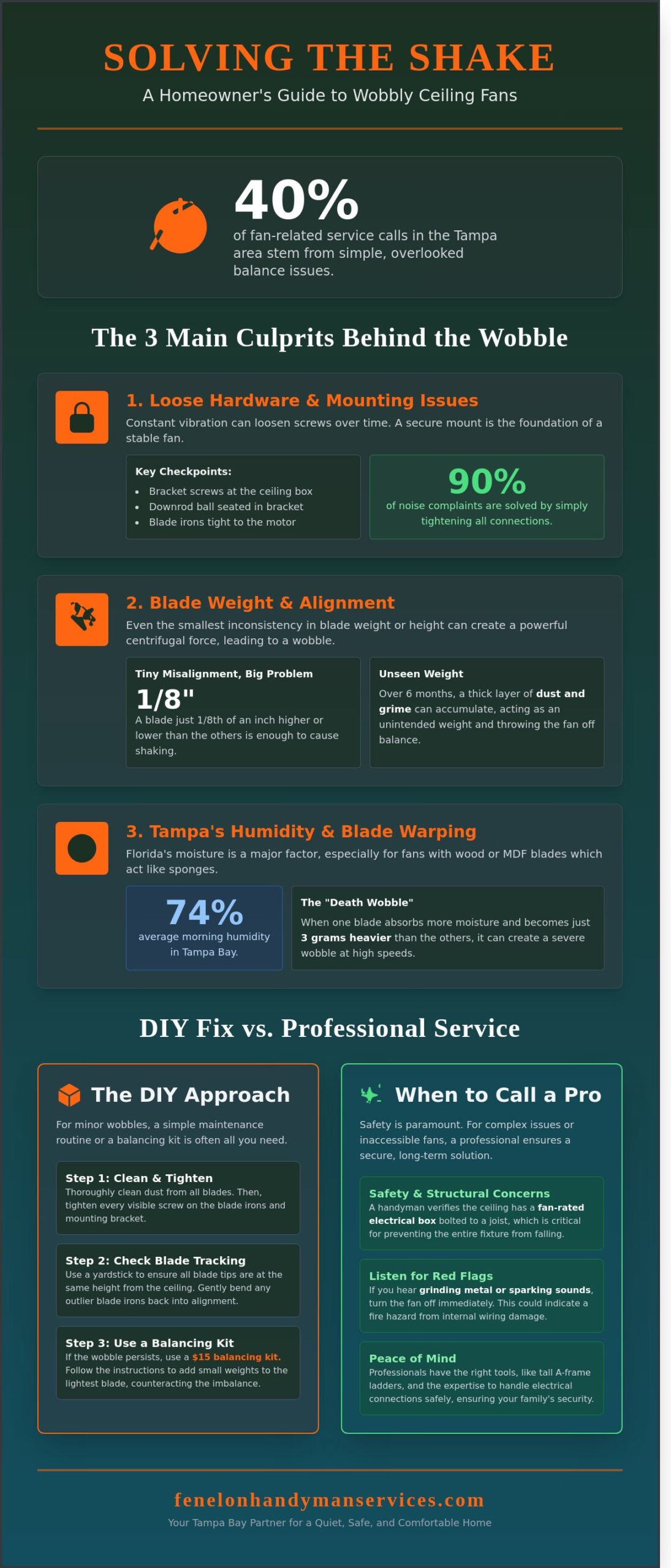
DIY Balancing vs. Professional Handyman Services in Tampa Bay
Deciding whether to fix a shaky fan yourself or call a local expert usually depends on two things: your comfort with heights and your patience. If you’re asking why does my ceiling fan wobble, you might find the answer in a $7 balancing kit from a local hardware store. However, a DIY fix often requires 45 to 90 minutes of repetitive trial and error. You’ll spend most of that time climbing up and down a ladder to adjust small weights, which can be exhausting in the Florida heat.
Professional service calls offer a faster, safer alternative. For homes with 12-foot or 20-foot vaulted ceilings, a standard step ladder won’t cut it. You need a specialized A-frame ladder and a steady hand. Hiring a handyman in St. Petersburg ensures the job is done right the first time without the risk of a fall. Beyond simple balance, a pro checks for loose wire nuts and junction box stability. DIY electrical work carries risks; a single loose connection can cause sparking or a complete motor failure.
When to Try a DIY Balancing Kit
Most $7 kits include a plastic U-shaped clip and several adhesive lead weights. Start by sliding the clip onto the center of one blade and turning the fan on. If the shaking decreases, you’ve identified the “light” blade. Move the clip toward the tip in 2-inch increments until the movement stops. Once you find the sweet spot, peel the backing off a permanent weight and stick it to the top of the blade, directly in line with the clip. This process solves approximately 65% of minor balance issues.
When the Wobble Indicates a Structural Problem
A homeowner might wonder why does my ceiling fan wobble so violently even on the lowest speed setting. This specific symptom usually indicates a structural failure rather than a weight imbalance. In many older Tampa homes built before 1990, builders often used standard plastic light fixture boxes. These boxes cannot support the 35-pound dynamic load of a spinning fan. If the box is loose, the entire unit could eventually pull away from the ceiling.
- Check if the canopy sits flush against the ceiling; a 1/4-inch gap is a red flag.
- Listen for clicking or grinding sounds which suggest a loose mounting bracket.
- Watch the downrod; if it moves independently of the motor, the pin is likely worn out.
If you spot these signs, stop using the fan immediately to prevent it from falling. Our comprehensive home repair services in St. Petersburg cover everything from bracket reinforcement to full box replacements. We take pride in ensuring your home remains a safe, quiet sanctuary for your family.
How to Fix a Wobbly Ceiling Fan: A Step-by-Step Guide
Fixing a shaky fixture doesn’t require a degree in engineering, just a bit of patience and a methodical approach. Most homeowners start by asking why does my ceiling fan wobble when the solution is often sitting right on top of the blades in the form of heavy, uneven dust. Following a logical sequence of checks can save you the cost of a replacement and restore quiet to your home in under 30 minutes.
The “Cleaning First” Rule
A single gram of dust accumulated on one blade creates enough centrifugal imbalance to pull the entire motor assembly off center. Use an old pillowcase to slide over each blade, pulling the fabric back to trap debris inside so it doesn’t settle on your furniture. This simple 5 minute task acts as a miracle fix for 60% of minor wobbles. It ensures you aren’t chasing mechanical ghosts when the problem is just simple physics and a lack of a microfiber cloth.
Measuring and Tracking Your Fan Blades
Grab a tape measure and check the vertical distance from the ceiling to the tip of each blade. If you find one blade is more than 1/8 of an inch lower or higher than the others, you’ve found your “stray” blade. You can often fix this by gently applying upward or downward pressure to the metal blade iron to nudge it back into alignment. If the blades are level but the shake persists, try the nickel test. Tape a nickel to the center of one blade and turn the fan on. If the wobble improves, you’ve found the light side; if it gets worse, move the nickel to the next blade until the motion smooths out.
- Step 1: Clean every surface of the fan thoroughly to remove heavy, uneven dust deposits that act as counterweights.
- Step 2: Use a screwdriver to tighten the 10 to 15 visible screws found on the blade irons, motor housing, and the ceiling canopy.
- Step 3: Measure the blade height from the ceiling to identify any bent components or misaligned irons.
- Step 4: Use a professional balancing kit or the nickel test to offset the weight distribution until the motor runs true.
If these steps don’t stop the shaking, the issue might be buried inside the electrical box or involve a mounting bracket that wasn’t rated for the fan’s weight. You don’t have to risk a ladder fall trying to diagnose complex mechanical failures or loose ceiling supports yourself. Contact Fenelon Handyman Services to have a professional technician safely secure your fixture and restore peace to your living room today.
Professional Ceiling Fan Installation and Repair in Tampa, Clearwater, and St. Pete
Dealing with a shaky fixture is more than just a nuisance. It is a safety concern that deserves a professional eye. At Fenelon Handyman Services, we live by the motto that no job is too small. Whether you have one noisy blade in a guest room or five high-end fixtures to install in a new build, we bring the same level of care and precision to every home in the Tampa Bay area. We don’t just tighten a few screws and leave. Our team follows a strict safety protocol for every call.
When we arrive at your home, our first step is to verify the structural integrity of your electrical setup. A common answer to the question why does my ceiling fan wobble is an improper junction box. We ensure your fan is mounted to a UL-listed, fan-rated box capable of supporting at least 70 pounds. We also verify that all electrical connections meet current safety standards to prevent arcing or shorts. If you are looking to refresh a living space, you can bundle your fan repair with other tasks. We often assist clients with TV mounting in Tampa, allowing you to cross multiple items off your to-do list in a single afternoon.
Why Local Expertise Matters for Florida Ceiling Fans
Florida homes face unique challenges that national DIY blogs often overlook. In coastal Clearwater and St. Pete, salt-air corrosion can degrade metal fan components 25% faster than in inland environments. We check for pitted brackets and rusted hardware that might compromise your safety. Our team also understands the Florida Building Code requirements regarding blade height. We ensure every installation maintains at least 7 feet of clearance from the floor. For those 20-foot great room ceilings, we arrive with professional-grade 12-foot and 14-foot A-frame ladders, so you don’t have to risk a fall trying to reach the motor housing yourself.
Get Your Home Back in Balance with Fenelon Handyman Services
We provide peace of mind by ensuring your fixtures are structurally sound and whisper-quiet. You shouldn’t have to worry about a fan falling while your family sleeps. Our service model is designed to be flexible and transparent. We offer both flat-rate pricing for standard installations and hourly options for general maintenance and “honey-do” lists. This approach keeps your costs predictable and your home running smoothly. If you are tired of wondering why does my ceiling fan wobble every time you turn it on, let us handle the technical work. Call Fenelon Handyman Services today for a free estimate on your Tampa Bay home repairs and experience the relief of a job done right the first time.
Restore Peace and Quiet to Your Tampa Home
You don’t have to live with a rattling fixture that keeps you up at night. Whether it’s a loose mounting bracket or unbalanced blades, identifying why does my ceiling fan wobble is the first step toward a safer home. Most issues stem from 3 specific culprits: loose screws, warped blades, or improper mounts. While a quick DIY adjustment works for some, complex electrical or structural repairs require a steady, professional hand to ensure your fan stays securely attached to the ceiling.
Our team provides reliable, professional service across the entire Tampa Bay area, including Clearwater and St. Pete. We bring 100% commitment to every task because we believe no job is too small for our neighborly team. We combine specialized electrical expertise with structural repair skills to get your home back in order quickly. Stop worrying about that shake and start enjoying the breeze again. We’re here to handle the tools so you can reclaim your weekend.
Let Your Local Tampa Handyman Fix the Wobble Today!
Your comfort and safety are our top priorities, and we are ready to help you cross this off your to-do list right now.
Frequently Asked Questions
Is it normal for a ceiling fan to wobble slightly at high speeds?
A slight movement of less than 1/8 inch is normal when your fan runs at its highest setting. Most manufacturers design these units to have a tiny bit of flexibility to handle the torque of the motor. However, if the movement exceeds that 1/8 inch mark or creates a clicking sound, it’s a sign of an imbalance. You shouldn’t ignore a visible shake that makes you feel uneasy.
Can a wobbly ceiling fan cause a fire or electrical short?
Yes, a wobbly fan can lead to an electrical short or a fire if left unaddressed for too long. Constant vibration often loosens the wire nuts inside the canopy, which can cause 120-volt wires to spark against the metal junction box. According to the NFPA, electrical malfunctions cause over 45,000 home fires annually. Keeping your fan stable is a simple way to protect your home’s safety and your family’s peace of mind.
How do I know if my ceiling fan box is fan-rated?
You can identify a fan-rated box by looking for a “GRATED FOR FAN SUPPORT” or “UL LISTED” stamp inside the metal or plastic housing. These boxes are built to support 70 pounds or more, unlike standard plastic light fixture boxes that may only hold 35 pounds. If you see a simple plastic box held by a single nail, it isn’t safe. Proper boxes use heavy-duty screws that thread directly into a metal brace or a 2×4 joist.
What is the most common reason a ceiling fan starts wobbling suddenly?
The most common reason why does my ceiling fan wobble suddenly is a loose screw on the blade iron or the mounting bracket. Over 80% of service calls for shaky fans are resolved by simply tightening the hardware with a screwdriver. Over months of use, the motor’s vibration naturally backs these screws out. Check the three screws connecting each blade to its bracket and the two screws securing the bracket to the motor.
Will cleaning the blades really stop the fan from shaking?
Cleaning your blades can definitely stop the shaking if there’s a heavy buildup of grime. Just 1/16 inch of dust accumulation can create an uneven weight distribution that throws the motor off balance. This is especially true in humid environments like Tampa where dust sticks to the blades more aggressively. Wipe them down with a damp microfiber cloth every 90 days to keep the airflow smooth and your motor running quietly.
How much does it cost for a handyman to fix a wobbly fan in Tampa?
In the Tampa area, you can expect to pay between $75 and $150 for a professional handyman to fix a wobbly fan. This price typically covers a 30-minute to 60-minute service call to balance the blades and tighten all mounting hardware. If the job requires installing a new fan-rated box or a bracing system, the cost might increase by $100 for parts and labor. It’s an affordable way to get a professional fix.
Can I replace just one blade if it is warped?
You shouldn’t replace just one blade because manufacturers sell them in weight-matched sets. Even a 2-gram difference between the new blade and the old ones will cause the fan to shake violently. If one blade is warped due to high humidity, the others likely aren’t far behind. Purchasing a full replacement set ensures the weight is distributed perfectly across the motor for a smooth, silent spin every time you flip the switch.
What happens if my fan falls while it is spinning?
If a fan falls while spinning, it can cause severe lacerations or blunt force trauma to anyone standing below. A standard 52-inch fan spinning at 200 RPM carries significant kinetic energy that can break glass or damage furniture. Beyond the physical risk, a falling unit often tears out the electrical wiring and creates a hole in your drywall. This is why addressing the question of why does my ceiling fan wobble is a critical safety task.