
Last Tuesday, a family in South Tampa discovered that their three-month-old floors were already peaking at the seams due to the 85% indoor humidity levels we see every summer. It’s a frustrating reality for many homeowners who realize too late that the wrong choice in the vinyl vs laminate flooring Florida debate can lead to a $4,000 replacement mistake. You want your home to look incredible, but you also need a surface that can handle tracked-in Gulf Coast sand and the occasional wet paw print without warping or buckling.
We agree that your home is your biggest investment; you shouldn’t have to settle for floors that can’t keep up with your lifestyle. This guide breaks down exactly how these two popular options perform in our unique climate. You’ll learn which surface offers 100% waterproof protection and which provides the best scratch resistance for high-traffic areas. We’re going to compare durability, maintenance, and costs so you can choose a floor that stays beautiful for the next 15 years, no matter what the Florida weather throws your way.
Key Takeaways
- Learn how Tampa’s humidity and concrete slabs affect your floor’s stability and why moisture-sealing is a critical step for Florida homes.
- Discover why 100% waterproof Luxury Vinyl Plank (LVP) is the top choice for keeping your bathrooms and kitchens safe from Gulf Coast moisture.
- Compare vinyl vs laminate flooring Florida options to see which surface stands up best to the daily wear of sand, pets, and active family life.
- Learn to decode AC ratings and sound profiles so you can choose a floor that is both scratch-resistant and quiet underfoot.
- See how professional installation and the “no job too small” approach ensure your new floors are leveled and prepped for long-term reliability.
The Florida Flooring Challenge: Why Climate Matters in Tampa Bay
Living in Tampa Bay means dealing with more than just sunshine. Our local weather creates a unique environment that tests the limits of any home renovation. In cities like Clearwater and St. Pete, humidity levels frequently soar above 60%, making the choice between vinyl vs laminate flooring Florida homeowners face a critical decision. Choosing the wrong material leads to buckling or warped boards within months of installation. It’s a common headache we see when homeowners try to use products designed for drier northern climates.
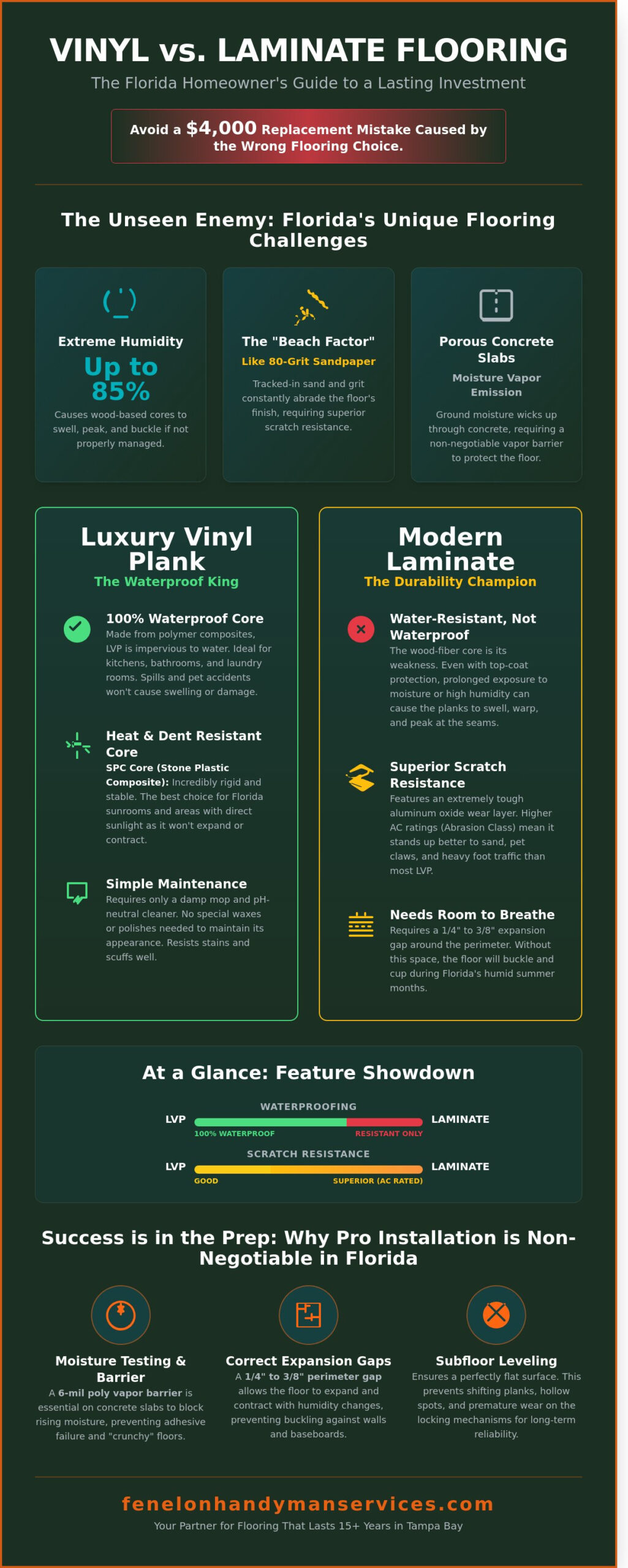
Different Flooring types react differently to our coastal air. By 2026, manufacturing technology has advanced significantly, giving us waterproof laminates and rigid core vinyls that didn’t exist five years ago. However, the “Beach Factor” remains a constant threat. Tracked-in sand acts like 80-grit sandpaper on your floor’s finish, so durability is just as vital as moisture resistance. You need a floor that can handle both the wet air and the grit from a weekend at the Gulf.
To better understand how these materials perform in real-world conditions, watch this helpful comparison:
Humidity and the Expansion Gap
High humidity causes wood-based cores to swell. If your floor doesn’t have room to move, it will “cup” or peak at the seams during a heavy summer storm. A professional flooring installation in Tampa requires a 1/4 inch to 3/8 inch perimeter expansion gap. This space allows your floor to breathe without damaging your baseboards. We’ve seen many DIY jobs fail because the planks were tight against the wall, leaving no room for the natural 2026 material expansion cycles.
Concrete Subfloors and Moisture Vapor
Most Tampa homes sit on concrete slabs. These slabs are porous and naturally pull ground moisture upward through capillary action. We always start with a moisture test to check for vapor emission rates. Using a 6-mil poly vapor barrier is a non-negotiable step to protect your investment. Without it, the high alkalinity in Florida concrete can eat away at flooring adhesives over time. This leads to shifting planks and a floor that feels “crunchy” when you walk on it. Taking the time to prep the subfloor correctly saves you thousands in repairs later. Just like protecting your floors from moisture below, proper gutter cleaning in Florida prevents water damage from above by directing rainwater safely away from your foundation.
Luxury Vinyl Plank (LVP): The Waterproof King for Gulf Coast Homes
Living in the Tampa Bay area means dealing with humidity levels that often hover above 70 percent. For local homeowners, choosing between vinyl vs laminate flooring Florida residents can rely on usually comes down to one factor: moisture. Luxury Vinyl Plank (LVP) stands as the top choice because it’s 100 percent waterproof from the surface to the core. Unlike other materials that swell when they get wet, LVP stays stable even if your kids run in from the pool with soaking wet feet or you track in sand and saltwater from a day at Clearwater Beach.
Maintenance is another reason Tampa families stay loyal to LVP. You don’t need special waxes or expensive cleaners to keep these floors looking new. A simple damp mop and a pH-neutral cleaner are all it takes to handle the dirt and allergens that blow in through open windows. For a deeper look at how these materials stack up, this guide on vinyl vs. laminate flooring explains the structural differences that make vinyl so resilient in high-traffic areas.
SPC vs. WPC: Which Core is Best for Florida?
Not all vinyl is created equal. SPC (Stone Plastic Composite) features a core made of limestone and stabilizers, making it incredibly rigid and heat-resistant. This is vital for Florida sunrooms where temperatures can spike past 90 degrees Fahrenheit. SPC won’t expand or contract like older vinyl generations. WPC (Wood Plastic Composite) uses a foaming agent to create a softer, quieter feel underfoot. While WPC is comfortable in a master bedroom, SPC is the better bet for rooms with heavy furniture or direct afternoon sun.
The Waterproof Advantage in Bathrooms and Kitchens
LVP has become a standard requirement for any bathroom remodeling in Clearwater. It offers the look of high-end white oak or reclaimed barn wood without the risk of rot. In a kitchen, LVP survives common “disasters” like a leaking refrigerator water line or AC condensation drips that might go unnoticed for hours. Modern printing technology provides high-definition textures that feel like real wood grain, giving you the aesthetic of hardwood with the durability of plastic. If you’re ready to upgrade your space, your local handyman can help you select a wear layer that stands up to heavy coastal living.
Modern Laminate Flooring: Durability and Scratch Resistance in 2026
Laminate flooring has undergone a massive transformation over the last few years. For homeowners weighing the pros and cons of vinyl vs laminate flooring Florida, the decision often comes down to how well the surface handles daily wear. While vinyl is known for being waterproof, laminate holds a secret weapon in its construction. It features an exceptionally hard wear layer made of melamine resin and aluminum oxide. This combination creates a surface that is significantly tougher than the PVC used in vinyl planks.
Battling the Sand: Laminate’s Scratch Resistance
Living near the Gulf means sand inevitably finds its way into your home. Sand acts like coarse sandpaper underfoot, grinding into floor surfaces with every step. Laminate is the clear winner for homes with large dogs or active kids because its top layer resists the micro-abrasions that eventually dull a vinyl floor’s finish. This melamine shield ensures that your floors keep their original luster even in high-traffic hallways where grit is common.
The AC rating system is the industry standard used to rank a floor’s durability against wear and impact.
When you are browsing samples, look specifically for an AC4 or AC5 rating. An AC4 rating is designed for heavy residential use, while AC5 is rugged enough for commercial spaces. In a busy Tampa household, choosing an AC5 laminate provides a level of security that softer materials simply cannot match. It’s the kind of reliability we look for when recommending products that will last for a decade or more.
Water-Resistant Technology in 2026
By 2026, the gap between “water-resistant” and “waterproof” has narrowed thanks to new hydro-seal edge technologies. Manufacturers now treat the tongue-and-groove joints with hydrophobic coatings that prevent water from reaching the wood-fiber core. Most premium laminate products now offer 72-hour protection against surface spills. This is more than enough time to clean up a knocked-over glass of sweet tea in the living room or a wet footprint in the bedroom.
Modern laminate also offers a distinct aesthetic edge because the planks are often thicker and more rigid than vinyl. This allows for deeper embossing that mimics the grain and texture of real oak or hickory. When you walk across it, the floor feels solid and warm rather than plastic-like. You can find a detailed breakdown of these material differences in this Forbes’ Guide to Vinyl vs. Laminate, which highlights why texture matters for home value.
While these advancements make it a great choice for most of the home, we still suggest caution in high-moisture zones. In a laundry room where a heavy leak might go unnoticed for days, the 100% moisture immunity of vinyl is still the safer bet. However, for the rest of your vinyl vs laminate flooring Florida project, laminate’s scratch resistance and realistic feel make it a tough competitor to beat.
Vinyl vs. Laminate: Head-to-Head Comparison for Tampa Homes
Choosing the right material often comes down to how you actually live in your home. We’ve seen plenty of floors in the neighborhood, and the debate over vinyl vs laminate flooring Florida homeowners face usually starts with daily wear. Vinyl generally lasts 20 to 25 years in high-traffic areas. Laminate offers a 15 to 25-year lifespan, though it’s more susceptible to the local humidity. If you walk around in flip-flops or have a 70-pound Golden Retriever, sound matters. Laminate can produce a hollow “clack” sound when hit by hard soles or paws. Vinyl is denser and absorbs noise better, making it the quieter choice for an active household.
Tampa buyers look for materials that handle the heat. In terms of resale, local real estate trends in 2024 show that 85% of buyers prefer luxury vinyl because of its moisture resistance. Eco-friendliness has also improved. By 2026, new manufacturing standards ensure both options meet strict VOC emission limits. Many 2026 product lines now feature 40% recycled content, helping you stay green while keeping your home beautiful.
The Cost-Value Analysis
Material costs in the local market typically range from $2.50 to $6.50 per square foot for luxury vinyl plank (LVP). High-quality laminate usually sits between $1.75 and $5.00. Because LVP is often faster to score and snap, your local handyman can typically finish a 400-square-foot room in roughly 5 to 7 hours. This speed helps keep your total project price down. For a Florida rental property, vinyl offers a 12% higher long-term ROI. It survives the humidity spikes and tenant spills that often cause laminate cores to swell and fail.
Room-by-Room Recommendation
- Best for Sunrooms: SPC Vinyl. The stone-plastic composite core won’t warp or expand even when the Florida sun hits 100 degrees.
- Best for Living Areas: High-end Laminate. It offers superior scratch resistance against sliding furniture and heavy foot traffic.
- Best for Bathrooms: LVP. Its 100% waterproof nature provides peace of mind that laminate simply can’t match in wet environments.
Every home is different, and we want to make sure yours gets the right treatment. If you’re ready to upgrade your space, you can book a flooring consultation with our team to get the job done right the first time.
Professional Flooring Installation in Tampa: Ensuring Long-Term Value
Choosing between vinyl vs laminate flooring Florida residents often find themselves overwhelmed by the technical details of the installation itself. At Fenelon Handyman Services, we believe that the “No Job Too Small” philosophy is the backbone of a high-quality home. Whether you need a single room updated or a small repair where a transition strip has failed, we bring the same level of precision to every task. Professional installation isn’t just about laying planks; it involves a rigorous process of leveling, prepping, and moisture-sealing to protect your investment from the 74% average humidity found in the Tampa area.
Many DIY projects fail because they overlook the small details that prevent material failure. We focus on installing professional transition strips that do more than just look good. These strips prevent tripping hazards and allow for the natural expansion of your floors, which accounts for nearly 40% of preventable flooring repairs in local homes. Your local handyman ensures that every edge is tucked and every seam is tight, giving you a result that lasts for decades.
The Importance of Acclimation
Florida’s climate is unique, and your new flooring needs time to introduce itself to your home’s specific environment. You must let your vinyl or laminate planks sit in your Tampa home’s air conditioning for 48 to 72 hours before the first plank is laid. Skipping this step leads to 1/4-inch gaps or dramatic buckling as the material reacts to your indoor temperature. We manage this timeline for you, ensuring the environment is just right before we begin the work.
Subfloor Leveling and Prep
A floor is only as good as what lies beneath it. We use specialized techniques to grind down high spots in Florida concrete or fill dips to ensure a surface that is flat within 3/16 of an inch over a 10-foot radius. If you’re planning a full room refresh, we can also coordinate with our painting services in Tampa to ensure your baseboards and walls look as fresh as your new floors. Proper prep work prevents the “hollow” clicking sound often associated with poorly installed vinyl vs laminate flooring Florida projects.
Don’t let a small flooring project turn into a long-term headache. Trust your local handyman to handle the heavy lifting and the fine details. We take pride in our tools and our reputation, showing up on time to get the job done right. Contact us today to schedule your estimate and experience the peace of mind that comes with professional craftsmanship.
Step Into a Better Home with Expert Tampa Flooring
Choosing the right material between vinyl vs laminate flooring Florida homeowners need depends on your specific space and daily routine. If you’re tackling high-moisture areas like kitchens or bathrooms, 100 percent waterproof luxury vinyl remains the top choice for our humid Gulf Coast climate. For living rooms where durability is the main priority, modern 2026 laminate offers impressive scratch resistance that stands up to kids and pets. Since 2021, Fenelon Handyman Services has provided reliable home remodeling and flooring solutions across Tampa, Clearwater, and St. Pete. We understand how Florida’s unique moisture levels can impact an installation. We focus on precision to prevent warping or buckling. You deserve a floor that looks beautiful and lasts for decades without the stress of a DIY mishap. Our team takes pride in every small detail. Don’t settle for less than professional results. Your home is in safe, capable hands from start to finish.
Get a Free Flooring Installation Estimate from Your Local Tampa Handyman
We look forward to helping you transform your living space into something you’ll be proud to show off to the neighbors!
Frequently Asked Questions
Is vinyl or laminate better for Florida humidity?
Vinyl is the superior choice for Florida because it’s made of synthetic materials that don’t expand or contract like wood-based laminate. When comparing vinyl vs laminate flooring Florida homeowners should know that laminate contains a wood fiber core that absorbs moisture at a rate of 8% to 12% in high humidity. This often leads to swelling and buckling in coastal regions. Vinyl remains stable even when humidity levels reach 90% or higher.
Can I install laminate flooring on a concrete slab in Tampa?
You can install laminate on a concrete slab if you use a 6-mil polyethylene vapor barrier to block rising moisture. Tampa slabs often sit on porous soil where moisture vapor emission rates can exceed 3 pounds per 1,000 square feet. Without this barrier, the wood fibers in the laminate will rot within 24 months. I always recommend testing the slab’s moisture level before the first plank goes down to ensure a long-lasting finish.
Which flooring is most scratch-resistant for dogs and beach sand?
Laminate flooring with an AC4 or AC5 wear rating provides the best protection against scratches from pets and abrasive sand. While vinyl is waterproof, its surface is softer and can show scuffs from 50-pound dogs or quartz sand particles more easily than high-pressure laminate. A quality AC4 laminate can withstand 4,000 revolutions in a Taber abrasion test without showing wear. It’s a rugged choice for active households.
Does vinyl flooring warp in the Florida sun?
Vinyl flooring can warp or cup if exposed to direct sunlight that raises the surface temperature above 85 degrees Fahrenheit. Standard LVP expands 1/32 of an inch for every 10-foot span when heated. To prevent this, use window tints that block 99% of UV rays or choose a Stone Plastic Composite (SPC) vinyl. SPC cores remain rigid and stable even when temperatures reach 140 degrees near sliding glass doors.
How long does it take a professional handyman to install flooring in a standard room?
A professional handyman can typically install 200 square feet of click-lock flooring in 6 to 8 hours. This timeframe includes the 2 hours needed for site prep, such as pulling up old carpet or removing 40 linear feet of baseboards. Larger rooms or complex layouts with 3 or more doorways will take longer. I focus on getting the job done right the first time so you can enjoy your new space by dinner.
Is luxury vinyl plank (LVP) truly 100% waterproof?
Luxury vinyl plank is 100% waterproof because its core consists of PVC and limestone rather than organic wood pulp. While the planks won’t swell if submerged for 72 hours, the subfloor beneath them remains vulnerable to mold. Water can still seep through the 0.5-millimeter seams between planks if a flood occurs. It’s the best option for bathrooms and laundry rooms where spills are a daily reality.
Should I use an underlayment with my new vinyl or laminate floors?
You should use an underlayment unless your flooring comes with a pre-attached 1-millimeter to 2-millimeter foam or cork pad. A dedicated underlayment provides a Sound Transmission Class rating of 60 or higher, which significantly muffles footsteps. It also smooths out minor subfloor imperfections up to 3 millimeters deep. When choosing vinyl vs laminate flooring Florida projects often require a specific moisture-blocking underlayment to protect against high ground humidity.
How do I clean sand off my new floors without scratching them?
Use a vacuum with the beater bar turned off or a soft microfiber dust mop to remove sand at least 3 times per week. Sand particles act like 60-grit sandpaper under your shoes, which can dull a floor’s finish in less than 12 months. Avoid using steam mops that reach 212 degrees, as the heat can weaken the adhesive bond on vinyl or cause laminate edges to peak. A simple pH-neutral cleaner is all you need for a safe shine.