Green board, purple board, and cement board explained for Tampa baths and laundry rooms, plus why backer board behind shower tile is not optional.
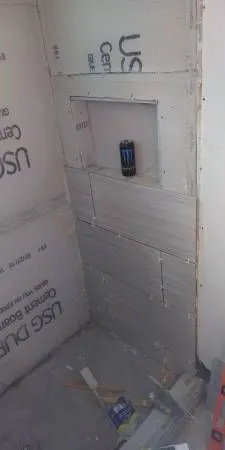
If you have ever pulled the trim off an old Tampa bathroom and found soft, crumbling, dark-stained drywall behind it, you already know why this topic matters. Standard drywall and Florida humidity are a bad match, and the wrong board in a wet spot turns into a mold farm fast. There is a whole family of moisture-resistant and water-resistant boards, and each one belongs in a specific place. Use the right one and you get a wall that lasts. Use the wrong one and you are re-doing the job in a few years.
Here is the plain-English breakdown of green board, paperless and purple board, and cement board, where each one goes, and the one rule you cannot break: backer board behind shower tile is not optional. We will keep it specific to how homes are built and how they get wet here in Tampa Bay.
Why standard drywall fails in humid Florida rooms
Regular drywall, the white-and-gray stuff in your living room, is a gypsum core wrapped in paper. The gypsum can tolerate a little moisture, but the paper facing is basically food for mold. Give it steam, a slow leak, or weeks of high humidity and the paper feeds a mold colony that spreads behind the wall where you cannot see it. In our climate that is not a rare accident. It is the default outcome in the wrong room.
Tampa runs warm and damp most of the year, indoor humidity climbs every time the AC struggles, and a lot of our housing stock is older block homes in neighborhoods like Seminole Heights and Temple Terrace where bathrooms were never built with moisture in mind. Standard drywall belongs in dry, conditioned rooms only. Anywhere that gets steamy, splashed, or stays humid needs a board built for it.
Green board: moisture-resistant, not waterproof
Green board is gypsum drywall with a treated, water-resistant paper facing, and yes, it is usually green. It handles humidity and the occasional splash far better than standard drywall, which makes it a solid choice for the walls and ceiling of a bathroom, a laundry room, or a wall near windows that sweat in summer. It is not waterproof. It resists moisture in the air, but it is not made to sit in water or take direct spray.
The single most important thing to know about green board: it does NOT go inside a shower or tub surround behind tile. That is a wet area, and green board is a damp area product. People confuse the two all the time and it is the most common reason a tiled shower fails.
Where green board belongs
- Bathroom walls outside the tub and shower splash zone
- Bathroom ceilings that get steamy from hot showers
- Laundry room walls around the washer and dryer
- Walls near windows that collect condensation in the summer
- Powder rooms and half baths with a sink but no shower
Paperless and purple board: extra mold resistance
If green board is the baseline upgrade, paperless and purple boards are the next step for serious mold resistance. Because the worst mold problems start with the paper facing, manufacturers make boards that remove that weak point. Paperless drywall uses a fiberglass mat instead of paper, so there is far less for mold to feed on. Purple board is a popular mold-and-moisture-resistant gypsum board that resists both moisture and mold better than standard green board.
For a Tampa bathroom that gets heavy daily use, a small windowless bath that never fully dries out, or any spot where you have already fought mold once, these boards are worth the modest extra cost. They cost a little more than green board but a lot less than tearing the wall out again. Think of them as cheap insurance in a climate that punishes the wrong choice.
- Paperless or fiberglass-faced board: best general mold resistance for humid baths and laundry rooms
- Purple board: strong moisture and mold resistance for high-use bathrooms
- Either one is a smart upgrade in windowless or poorly ventilated baths
- Still not a substitute for cement board inside a wet shower or tub area
Cement board: the real wet-area product
Behind the tile in a shower or tub surround, you need cement board, also called tile backer board. This is not gypsum at all. It is a cement-based panel that does not rot, does not soften, and will not feed mold the way paper-faced drywall does. It is the correct, code-respecting substrate for tile in a true wet area, and it is the structural base that holds your tile and waterproofing together.
Backer board behind shower tile is not optional. If a contractor or a DIY video tells you to set shower tile over green board, stop. That wall will fail. Tile and grout are not waterproof on their own, water gets through, and only a proper wet-area assembly survives it. There are also foam-style waterproof backer panels that do the same job, but the principle is identical: a wet-area board, not drywall, goes behind shower and tub tile.
Backer board still needs waterproofing
Here is the part people miss: cement board itself is not waterproof. It will not rot, but water can pass through it to the framing behind. That is why backer board has to be paired with a real waterproofing system. Done right, the assembly keeps water out of your wall cavity, which in a Tampa block or wood-framed home is exactly where you do not want it sitting.
- A waterproof membrane, either a liquid-applied coating or a sheet membrane over the backer board
- Taped and sealed seams and corners where water loves to sneak through
- A proper sloped shower pan or pre-formed pan so water drains instead of pooling
- Sealant at penetrations where the valve, spout, and fixtures go through the wall
The backer board and the waterproofing are a team. Skip the membrane and you still get a leak. This is where a lot of weekend shower projects quietly go wrong, and you do not find out until the grout starts cracking or the smell of mold shows up a year later.
Quick guide: which board goes where
When you are standing in the aisle trying to remember which board is which, here is the short version for Tampa homes:
- 1. Dry living areas, bedrooms, hallways: standard drywall is fine.
- 2. Bathroom walls and ceilings outside the shower, laundry rooms, walls near sweaty windows: green board, or paperless/purple board for extra mold resistance.
- 3. Inside a shower or tub surround behind tile: cement board or another wet-area backer panel, plus a waterproofing membrane.
- 4. Anywhere you have fought mold before: step up to paperless or purple board, not standard or green.
If you remember nothing else: damp rooms get a moisture-resistant board, wet showers get backer board with waterproofing, and standard drywall stays out of both.
When to call a pro
Hanging green board on a dry-ish bathroom wall is well within reach for a confident DIYer. Building a tiled shower from the studs out is a different animal, because the cost of getting the waterproofing wrong is a wall full of rot and mold that you cannot see until it is expensive.
- You are tiling a new shower or tub surround and need the backer and waterproofing done right the first time
- You opened a wall and found existing mold, soft drywall, or water-stained framing
- There is an active or suspected leak behind the wall, not just surface humidity
- You are in an older Seminole Heights or Temple Terrace bathroom and are not sure what is behind the tile
- The job involves moving plumbing, the valve, or the shower pan
If any of that sounds like your project, getting it looked at by a pro before you tile is a lot cheaper than tearing it out after. A wet-area assembly is one of those things that is easy to do correctly and very costly to do twice.
Curious whether the terms even mean different things: Sheetrock vs Drywall: What's the Difference?
For the painted walls outside the shower, the right paint helps too: Mold-Resistant Bathroom Paint for Tampa Homes
If you are patching a damp-area wall rather than rebuilding it: How to Patch Drywall the Right Way
Need the moisture-resistant board hung and finished correctly: Tampa Drywall Repair Services
Frequently asked questions
- Can I use green board in a shower?
- No. Green board is moisture-resistant, not waterproof, so it belongs on bathroom walls and ceilings outside the shower, not inside the wet tub or shower area behind tile. For shower tile you need cement board or another wet-area backer panel with a waterproofing membrane. Setting tile over green board in a shower is one of the most common reasons showers fail.
- Is cement board waterproof by itself?
- No, and that surprises a lot of people. Cement board will not rot or feed mold the way paper-faced drywall does, but water can still pass through it to the framing behind. That is why it has to be paired with a waterproofing membrane and sealed seams to keep your wall cavity dry, which matters a lot in humid Tampa.
- What is the difference between green board and purple board?
- Green board is standard moisture-resistant drywall with a treated paper facing, good for humid rooms and splashes. Purple board is a mold-and-moisture-resistant gypsum board that resists mold better than green board. In a heavy-use or poorly ventilated Tampa bathroom, the extra mold resistance of purple or paperless board is usually worth the small added cost.
- Do I really need moisture-resistant drywall in a Florida bathroom?
- It is strongly recommended. Tampa's year-round humidity and steamy showers are exactly the conditions that rot standard drywall and grow mold behind the wall. Green board on the walls and ceiling, with cement board in the shower, gives you a wall built for our climate instead of one that fails in a few years.
- Can I put moisture-resistant drywall over concrete block?
- Yes. In Tampa's concrete-block homes, drywall is typically attached to furring strips or framing over the block, and you can use moisture-resistant board there just as you would on a framed wall. The board choice still follows the room: green or purple board in damp areas, cement board and waterproofing inside the shower.
Planning a bathroom or laundry room project and want the right board and waterproofing done right the first time? Call Fenelon Handyman Services at (786) 509-5555 for a free, no-pressure quote. Get a free quote.
Drywall Repair in Tampa, FL
Done-for-you by an insured local crew — free quotes, same-week scheduling.
Need a hand with this in Tampa?
Get a free quote from a 4.8★ local crew. We answer fast and show up on time.
We handle this kind of work across Tampa Bay — including handyman service in Brandon, handyman service in Lutz, handyman service in Town 'N' Country and handyman service in Westchase. See all service areas.