
Galley kitchens get a bad reputation. Two parallel counters, a narrow walkway, and not much room to breathe, it’s easy to see why homeowners want to rip everything out and start over. But here’s the thing: galley kitchen remodel ideas don’t have to involve knocking down walls or blowing your budget. Some of the most efficient kitchens in the world, from restaurant lines to ship galleys, use this exact layout for a reason. It works when it’s designed well.
The real challenge isn’t the shape of the room. It’s figuring out how to squeeze more storage, counter space, and visual breathing room out of every square inch. That takes smart material choices, thoughtful cabinet configurations, and a few tricks that most homeowners wouldn’t think of on their own. If you’re dealing with Tampa’s humidity on top of it all, your material and ventilation decisions matter even more than usual, moisture and heat don’t forgive bad planning.
At Fenelon Handyman Services, we’ve been remodeling kitchens across the Tampa Bay area since 2014, and galley layouts are some of our favorite projects. There’s a real satisfaction in transforming a cramped, outdated kitchen into something that feels twice its size without adding a single square foot. Below, we’ve pulled together 14 practical ideas, from layout adjustments to storage solutions, that we’ve seen make the biggest difference in real galley kitchen remodels. Whether you’re planning a full renovation or just want a few targeted upgrades, you’ll find something here that fits.
1. Work with a licensed remodeler for a layout reset
Before you pick paint colors or cabinet hardware, you need to decide whether your galley kitchen’s current layout is worth keeping. Many homeowners skip this step and spend money on cosmetic upgrades that do nothing for the fundamental flow problems baked into the original floor plan. A licensed remodeler looks at the whole picture: where your plumbing stacks run, how your electrical circuits are distributed, and whether moving a wall or doorway is structurally and legally feasible in your specific home.
What this idea changes in a galley kitchen
A layout reset doesn’t always mean a full gut renovation. Sometimes it means relocating a single doorway to eliminate a dead-end walkway, or shifting the refrigerator to the end wall so it stops blocking counter runs. These targeted moves can dramatically change how the kitchen feels and functions without touching every surface. When you work through galley kitchen remodel ideas with a licensed professional, you get a set of solutions grounded in what your specific space can actually support, not just what looks good in a magazine.
A layout change that costs a few thousand dollars upfront can save you from spending twice that on workarounds later.
When to use a pro vs DIY
You can handle cosmetic work on your own: painting cabinets, swapping hardware, installing peel-and-stick backsplash. But the moment your project touches load-bearing walls, plumbing supply lines, or your electrical panel, you need a licensed contractor. In Florida, unpermitted structural or electrical work can create liability issues when you sell your home and may void your homeowner’s insurance if something goes wrong. A licensed remodeler also knows local Tampa building codes, which matter more than most homeowners realize.
Typical cost range and timeline in Tampa
A layout consultation and design phase with a licensed remodeler in Tampa typically runs $300 to $800 depending on the scope. If you move forward with structural changes, such as relocating a doorway or shifting a plumbing fixture, budget $2,500 to $8,000 for that work alone, separate from finishes. Most targeted layout resets take one to three weeks from permit approval to completion, though larger projects with multiple trades can stretch to six weeks.
2. Open one side with a pass-through or half wall
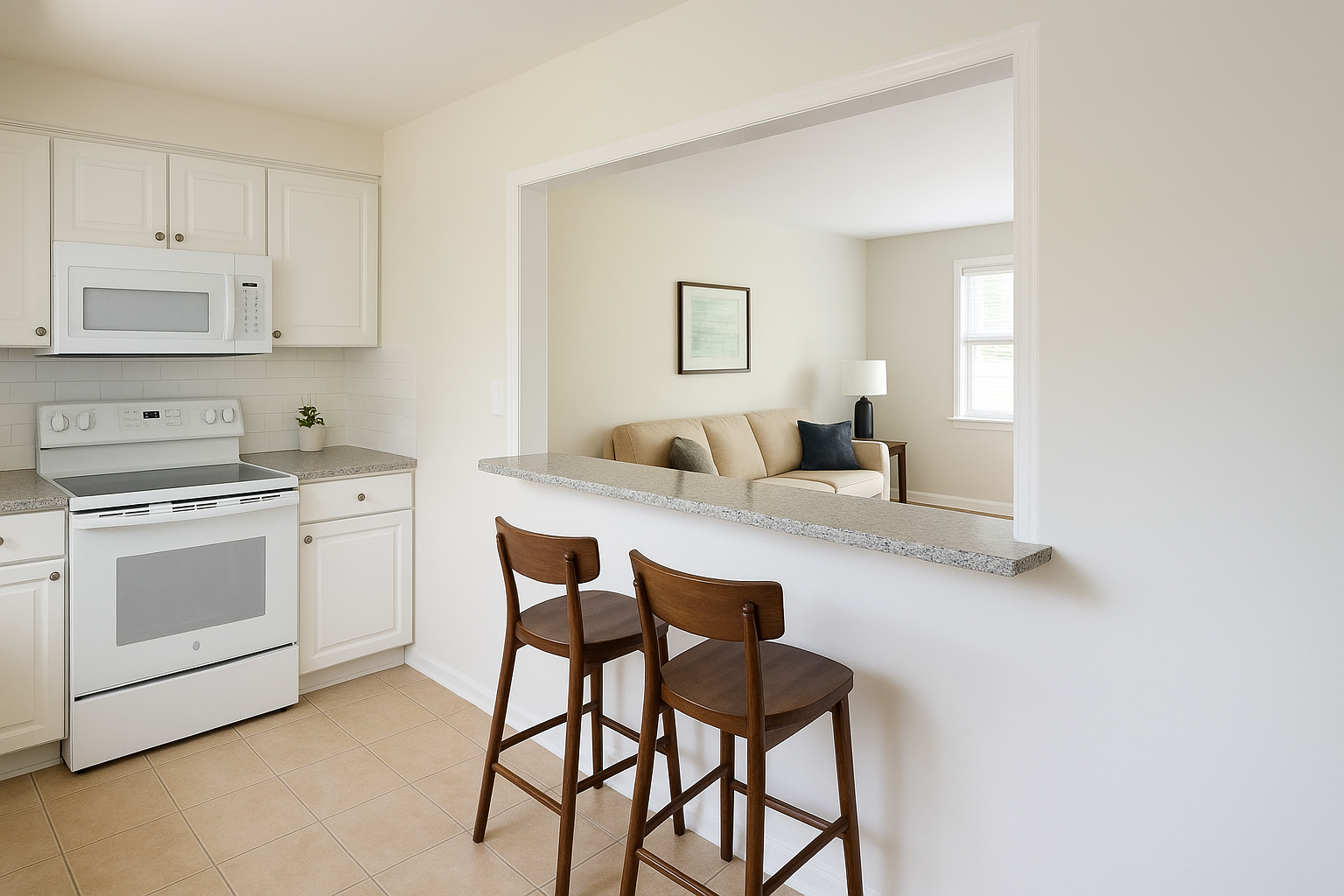
Opening one side of a galley kitchen to an adjacent room is one of the most impactful galley kitchen remodel ideas for Tampa homeowners. A pass-through or half wall gives you the visual openness of an open floor plan while keeping the structural work manageable and the budget reasonable.
Layout options that keep some separation
A pass-through is a window-sized opening cut into the wall between your kitchen and a dining or living area. It lets light travel freely between spaces and makes it easy to hand off plates or talk with guests while you cook. You can add a small ledge at the opening to create a quick serving surface without adding any square footage.
A half wall keeps a waist-high barrier in place and gives you space to add bar stools on the living room side, turning a blank wall into seating for two or three people.
Either option makes your galley feel less like a corridor and more like the center of the home.
Best homes and floor plans for this change
This modification works best in ranch-style homes and single-story builds where the kitchen and dining area share a non-load-bearing wall. Most Tampa homes built between the 1970s and 1990s have exactly this setup. Before committing, have a contractor confirm the wall carries no structural load or hidden plumbing.
Typical cost range and timeline in Tampa
A pass-through opening in Tampa typically costs $800 to $2,500, depending on drywall finishing and trim work. A half wall with a countertop cap runs $1,500 to $4,000. Most projects wrap up in three to five days once permits are in hand.
3. Set the right aisle width and landing zones
Getting your aisle width right before anything else is one of the most overlooked galley kitchen remodel ideas. If your walkway is too narrow, even the most beautiful finishes won’t fix the frustration of two people bumping into each other every time someone opens the refrigerator.
Clearances that prevent bottlenecks and door conflicts
The National Kitchen and Bath Association recommends a minimum aisle width of 42 inches for a single-cook kitchen and 48 inches for a two-cook layout. Beyond the aisle itself, landing zones matter just as much. A landing zone is a stretch of counter within arm’s reach of a major appliance, giving you somewhere to set down hot pans or groceries without crossing the entire kitchen to find space.
Without proper landing zones, every cooking task takes twice as many steps and doubles the frustration.
Who benefits most from this planning step
Families with multiple people in the kitchen at once get the most from this planning step. If you have kids reaching into the snack cabinet while you cook, or a partner handling dishes while you prep, proper clearances keep everyone out of each other’s way without requiring a bigger room.
Typical cost range and timeline in Tampa
If your aisle and landing zones only need minor cabinet repositioning, costs typically run $500 to $2,000. A more significant reconfiguration that moves appliances or countertops can reach $3,000 to $7,000 in Tampa. Most aisle-focused adjustments wrap up within one to two weeks.
4. Put the sink, cooktop, and fridge in a tight work triangle
Among all the galley kitchen remodel ideas that affect daily cooking, appliance placement delivers the most immediate payoff. The classic work triangle connects your sink, cooktop, and refrigerator in a pattern that keeps movement short and deliberate. In a galley layout, this triangle naturally collapses into a straight line or a compact offset, which actually makes it easier to optimize than in larger, irregular kitchens.
Simple appliance placements that improve workflow
Place your refrigerator at one end of the galley so it acts as a starting point for food prep rather than a mid-aisle obstacle. Your sink works best near the center of one run, and your cooktop lands on the opposite wall or just a few feet away. This keeps wet work and heat sources separated without forcing you to cross the kitchen repeatedly during a single meal.
A tight work triangle cuts unnecessary steps during cooking, which matters most in a kitchen where every foot of floor space is already accounted for.
Best for busy cooks and multi-person kitchens
If you cook frequently or share the kitchen with a partner, reducing travel distance between appliances directly reduces frustration. A well-placed work triangle keeps one person in the prep and cooking zone while a second handles cleanup at the sink without the two paths crossing constantly.
Typical cost range and timeline in Tampa
Repositioning appliances without moving plumbing or gas lines runs $200 to $800 in Tampa. If your project requires relocating a sink drain or gas stub-out, budget $1,500 to $4,500. Most appliance reconfiguration work completes within one week.
5. Choose counter-depth or built-in appliances
Standard appliances stick out 6 to 8 inches past your cabinet faces, and in a galley kitchen, those extra inches cut directly into your aisle. Counter-depth and built-in appliances sit flush with your cabinets, immediately reclaiming several inches of walkable floor space without moving a single wall.
How slimmer appliances free up the aisle
Counter-depth refrigerators run 23 to 25 inches deep compared to 30 to 34 inches for standard models. That difference can push your aisle from a cramped 36-inch corridor to a much more workable 42-inch clearance. Built-in dishwashers and slide-in ranges follow the same principle, keeping your cabinet line clean and uninterrupted so the kitchen reads as one continuous surface rather than a row of obstacles.
Freeing up even four inches of aisle width changes how two people move through the same kitchen at once.
Best for narrow galleys and condo kitchens
This is one of the most practical galley kitchen remodel ideas for condos, townhomes, and older Tampa bungalows where the original aisle width was never generous. Counter-depth appliances work best when your kitchen falls into one of these situations:
- Your aisle measures under 42 inches with standard appliances in place
- You share the kitchen with another person during meal prep and cleanup
- Your current refrigerator blocks a cabinet run or creates a pinch point near the doorway
Typical cost range and timeline in Tampa
Counter-depth refrigerators in Tampa typically run $1,200 to $2,800 depending on brand and configuration. Slide-in ranges cost $900 to $2,200. A standard appliance swap takes one to two days with no permits required for a straight replacement.
6. Replace bulky doors with pocket or sliding doors
Standard swinging doors consume up to 9 square feet of floor space when fully open, and in a galley kitchen, that sweep cuts directly into your aisle clearance. Swapping them out for pocket or sliding doors is one of the most practical galley kitchen remodel ideas that pays off immediately in usable floor space and better traffic flow.
Where door swaps make the biggest difference
The most impactful locations are doorways that open directly into the main cooking corridor. A door that swings into your kitchen near the stove or refrigerator forces you to step back every time someone enters the room. Pocket doors slide into the wall entirely, eliminating the swing arc and leaving your aisle fully open.
Removing a door swing near a major appliance can recover 6 to 9 square feet of functional floor space without touching a single cabinet.
Best for galleys near laundry rooms and pantries
If your galley sits adjacent to a laundry room, pantry, or mudroom, the connecting door likely swings into one of those tight spaces constantly. A sliding barn door or a pocket door installation resolves the conflict cleanly and often becomes a visual feature rather than just a functional fix.
Typical cost range and timeline in Tampa
A sliding barn door in Tampa runs $400 to $1,200 installed, depending on hardware and door material. A pocket door conversion, which requires opening the wall to frame the pocket, costs $800 to $2,500. Most installs wrap up in one to two days.
7. Run cabinets to the ceiling with smart uppers
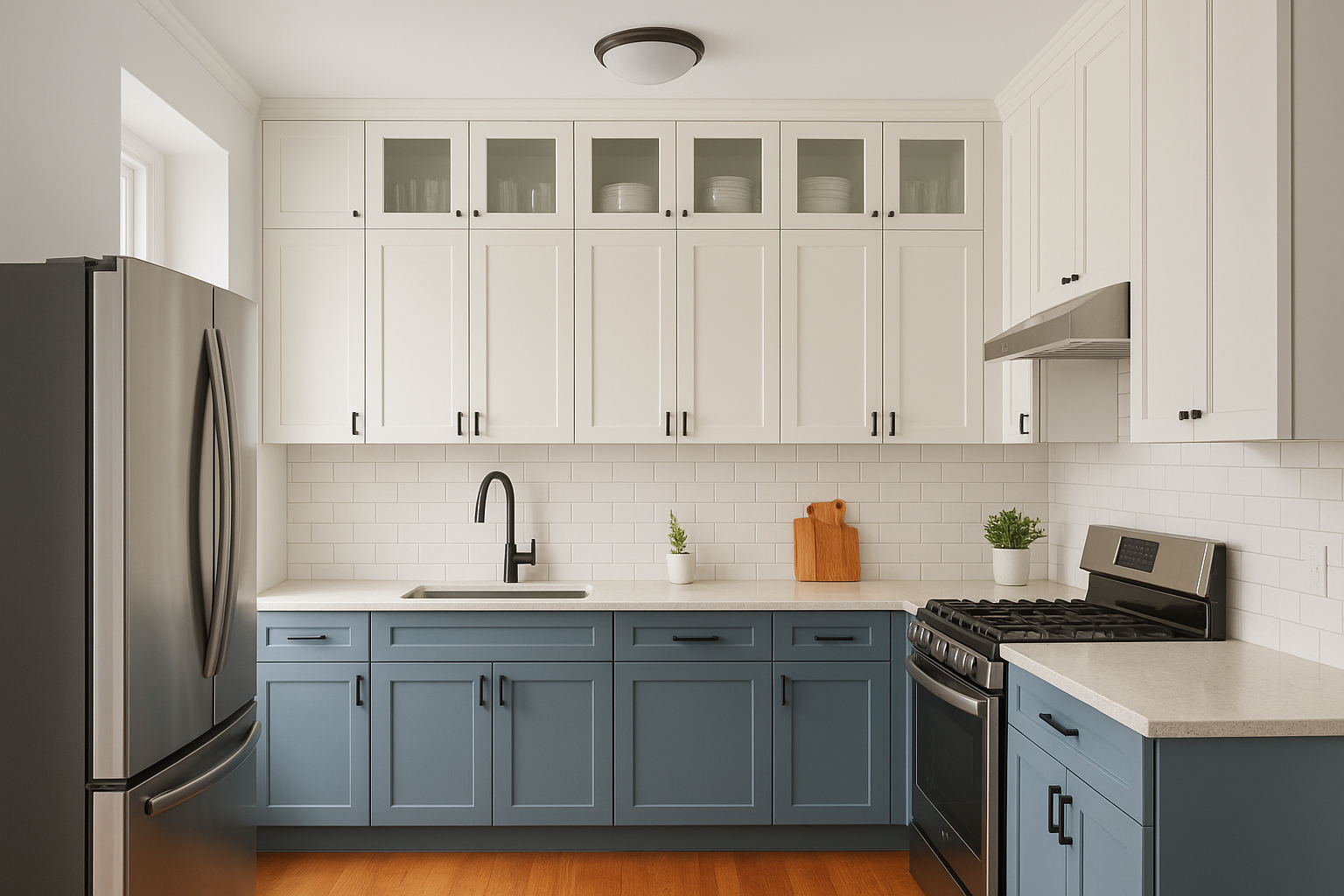
Most galley kitchens stop cabinet runs at 7 or 8 feet, leaving a dead zone above the uppers that collects dust and does nothing for your storage. Extending your cabinets all the way to the ceiling is one of the most overlooked galley kitchen remodel ideas because it requires no floor space at all. You’re using vertical square footage that’s already there.
Storage gains and how to avoid a boxed-in feel
Running cabinets to the ceiling can add 30 to 50 percent more storage to a galley kitchen without touching a single wall. The challenge is that a solid wall of wood above eye level can feel heavy and suffocating in a narrow space. You can counter that by using glass-front doors on the upper row so the eye travels through rather than stopping at the cabinet face. Lighter finishes on the top row also help the ceiling feel higher rather than closer.
Treating the upper cabinets differently from the lower ones, through finish, door style, or material, breaks up the visual weight and keeps the room from feeling like a storage closet.
Best for kitchens that lack a pantry
If your galley has no dedicated pantry, ceiling-height uppers compensate by giving you a home for rarely used items like seasonal cookware, bulk dry goods, and small appliances.
Typical cost range and timeline in Tampa
Adding upper cabinet runs to the ceiling in Tampa typically costs $1,500 to $4,500, depending on cabinet style and material. Most installs finish within three to five days.
8. Add pull-outs for pantry, trash, and spices
Pull-out inserts turn dead cabinet space into active storage without requiring you to widen a single cabinet or reroute any plumbing. This is one of the most budget-friendly galley kitchen remodel ideas because the work fits inside your existing cabinet boxes, meaning you get a major storage upgrade without a full cabinet replacement.
Pull-out types that add storage without widening cabinets
The three most useful pull-out types in a galley are pantry pull-outs, trash and recycling pull-outs, and spice pull-outs. A tall pantry pull-out replaces a standard base cabinet with deep, tiered shelves that roll out completely so you can see everything inside without digging. A trash pull-out keeps bins inside a cabinet and frees up the floor space a standalone can would occupy. Spice pull-outs fit into narrow gaps between cabinets and appliances, typically spaces as slim as three to six inches wide that would otherwise go unused.
Spice pull-outs are one of the few storage upgrades that use space most homeowners don’t even know they have.
Best for small kitchens with cluttered counters
If your counters currently hold a trash can, a spice rack, and stacked cans, you’re a strong candidate for pull-outs. Moving those items into dedicated inserts gives you back two to four linear feet of counter surface, which makes a significant difference in a narrow kitchen where every inch of prep space matters.
Typical cost range and timeline in Tampa
Pull-out inserts in Tampa typically run $150 to $600 per unit, depending on the type and brand. Professional installation adds $100 to $300 per cabinet, and most pull-out projects complete within one day.
9. Swap some uppers for open shelving or glass fronts
Replacing a row of solid upper cabinets with open shelving or glass-front doors is one of the most effective galley kitchen remodel ideas for making a narrow room feel larger. Solid cabinet faces act like walls, and in a tight corridor, every visual barrier you remove adds perceived width to the space.
How to lighten the room without losing function
You don’t have to remove all your uppers to feel the difference. Swapping two or three cabinet doors for open shelves or glass fronts on a single wall creates enough visual break to change how the kitchen reads. Open shelves push the eye past the cabinet face and into the depth behind it, which tricks your brain into reading the room as wider than it is.
Replacing just the cabinets that sit directly above your main prep counter makes the biggest visual impact for the least amount of work.
Best for homeowners who can keep surfaces tidy
Open shelving works best when your everyday dishes and glassware are presentable and you’re comfortable keeping surfaces organized. If your kitchen currently has crowded counters or a mix of mismatched containers, glass fronts are a better choice because they provide the same visual lightness while keeping clutter behind a door.
Typical cost range and timeline in Tampa
Removing upper cabinet doors and adding open shelves in Tampa runs $200 to $800 depending on shelf material and bracket style. Glass-front door replacements cost $400 to $1,500 for a standard run. Most installs finish within one to two days.
10. Use light colors and continuous surfaces
Color and surface choices are among the most underrated galley kitchen remodel ideas because they cost a fraction of structural work but deliver real visual impact. A dark kitchen with choppy material transitions feels smaller and heavier than it actually is. Switching to light, cohesive finishes across your cabinets, countertops, and walls is one of the fastest ways to make a narrow room feel more open without moving a single cabinet.
Color, finish, and material choices that widen the space
Light cabinet colors, soft whites, warm creams, and pale grays, push the walls back visually and let natural light bounce further into the room. Pairing your cabinets with a countertop in a similar tone removes the strong horizontal line that chops a galley into sections. Running the same flooring material continuously from one end of the kitchen to the other without transitions or pattern breaks also extends the perceived length of the room.
A monochromatic palette doesn’t mean boring; it means the room reads as one cohesive space rather than a series of competing surfaces.
Best for dark kitchens with limited natural light
This approach works best when your galley has one window or none at all, which is common in interior-facing kitchens in Tampa townhomes and older ranch homes. If your kitchen currently uses dark wood cabinets with a contrasting countertop, switching to lighter finishes delivers the most dramatic before-and-after difference of almost any finish upgrade.
Typical cost range and timeline in Tampa
Repainting or refacing cabinets in lighter colors in Tampa typically runs $800 to $3,500 depending on cabinet count and finish type. New countertops add $1,500 to $4,000. Most finish-focused updates complete within one to two weeks.
11. Add layered lighting for a brighter aisle
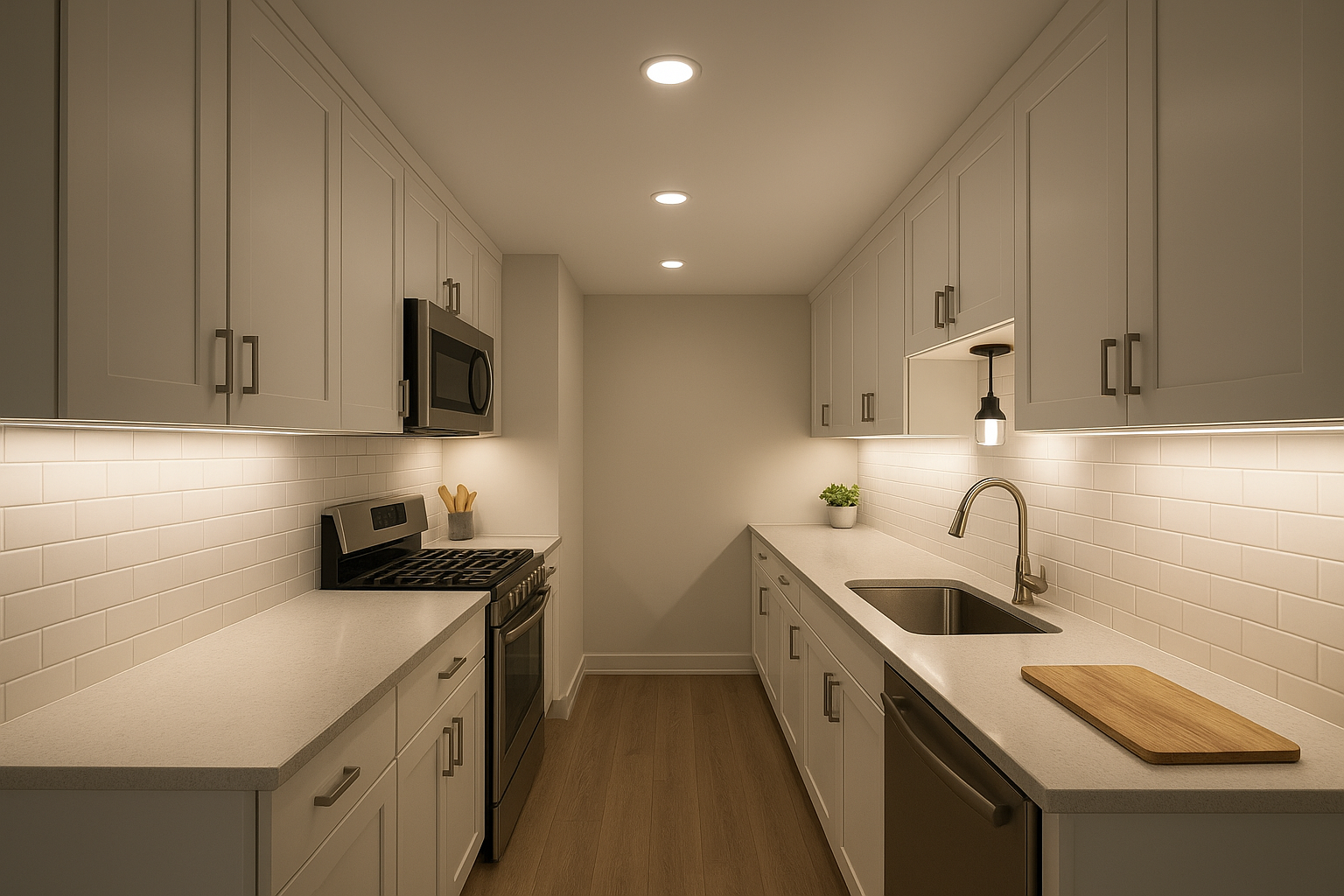
Lighting is one of the most affordable galley kitchen remodel ideas that changes how a room feels without touching a cabinet or wall. A single overhead fixture leaves dark corners at counter level and creates shadows exactly where you need to see most. Layering your sources across ceiling, under-cabinet, and task positions fills those gaps and makes your aisle feel wider and more functional.
Ceiling, under-cabinet, and task lighting placement
Recessed ceiling lights spaced 24 to 36 inches apart along the galley provide baseline brightness without the bulk of a hanging fixture. Under-cabinet LED strips throw direct light onto your prep surface and eliminate the shadow your body casts when standing at the counter.
Adding a pendant or track light over the sink ties the three zones together and gives you separate control over room mood through individual switches or dimmers.
Under-cabinet lighting is the fastest single upgrade that changes how usable your counters feel during evening meal prep.
Best for galleys with shadows over prep areas
If your current kitchen has one centered ceiling fixture, your counters are almost certainly in shadow during cooking. This setup is common in older Tampa homes where kitchens were treated as utility spaces rather than active work areas.
Adding under-cabinet strips and two or three recessed lights resolves the problem without any structural changes to the room.
Typical cost range and timeline in Tampa
Under-cabinet LED lighting and recessed fixtures are both affordable upgrades for most Tampa kitchens:
- Under-cabinet LED lighting: $150 to $500 installed
- Recessed ceiling fixtures: $200 to $400 per fixture including labor
- Full layered upgrade: $600 to $1,800 total
Most lighting projects wrap up in one day with no permits required for straightforward fixture swaps.
12. Use horizontal lines in tile and flooring
The direction of your tile and flooring patterns does more work than most homeowners expect. In a galley kitchen, horizontal lines draw the eye lengthwise down the room rather than across it, which stretches the space visually without adding a single square foot. This is one of the most cost-effective galley kitchen remodel ideas you can execute during a standard tile or flooring refresh.
Backsplash and floor patterns that stretch the room
A subway tile backsplash laid in a horizontal running bond pattern creates a strong directional pull that makes your galley feel longer. The same principle applies to your floor: plank flooring or rectangular tile installed parallel to the length of the kitchen rather than perpendicular to it exaggerates depth. Even grout lines contribute here since wider horizontal grout joints reinforce the effect.
Running your floor planks lengthwise down the galley is the single fastest layout trick that adds perceived depth to a narrow kitchen.
Best for short or choppy-looking galleys
This approach works best when your galley feels more like a box than a corridor, either because the room is short relative to its width or because doorways and cabinet breaks interrupt the visual flow. If your current backsplash uses vertical stacked tile or a busy mosaic pattern, switching to a clean horizontal layout immediately calms the room.
Typical cost range and timeline in Tampa
New backsplash tile in Tampa typically costs $400 to $1,200 installed for a standard galley run. Flooring replacement runs $1,500 to $4,000 depending on material. Most tile projects finish within two to four days.
13. Build a dining nook at the end
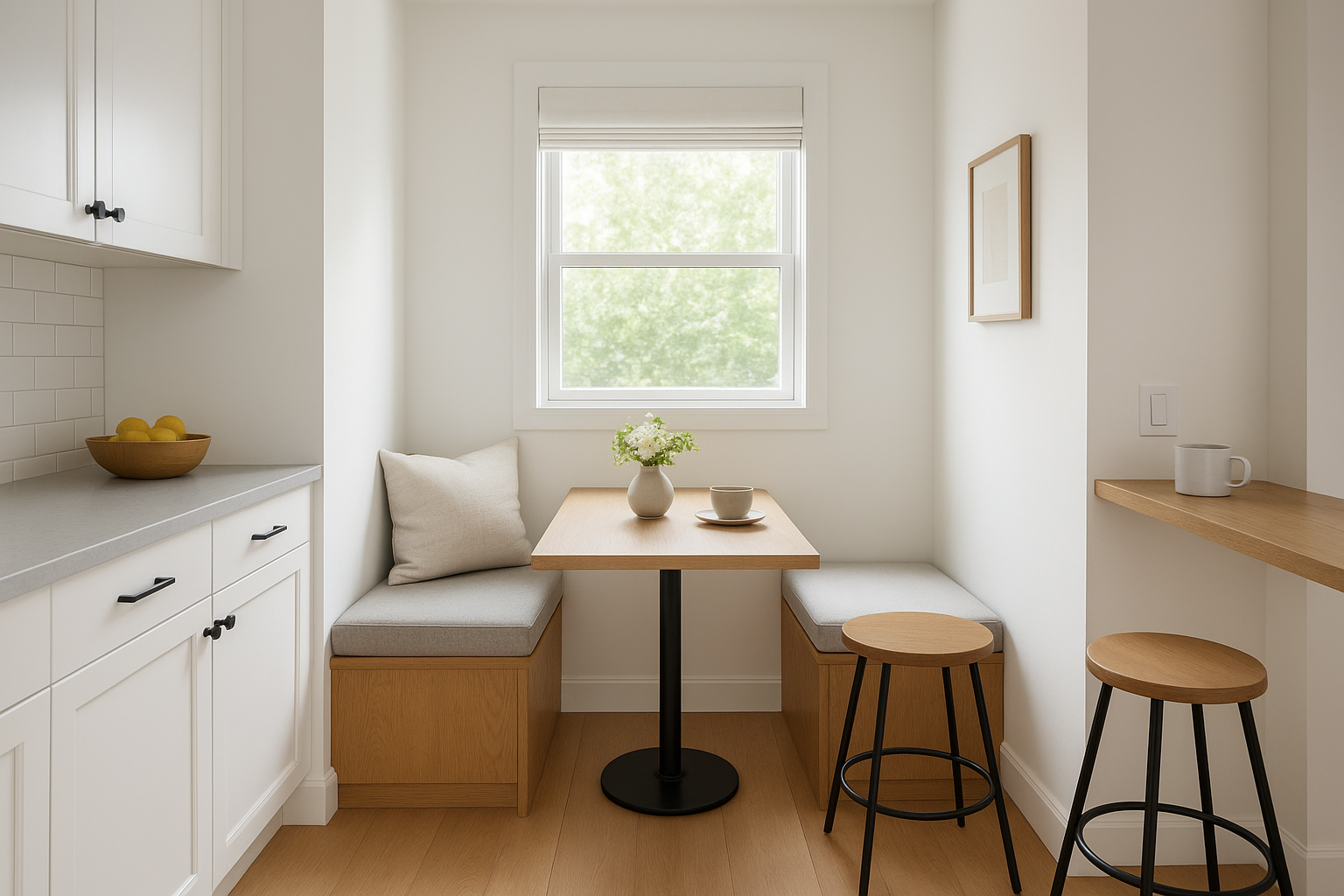
A dead-end wall at the far end of your galley is one of the most underused surfaces in the entire kitchen. Converting it into a compact dining nook is one of the more creative galley kitchen remodel ideas because it adds seating and function without pulling space from your cooking corridor.
Banquette, slim table, and breakfast bar options
Your three main options here are a built-in banquette, a slim pedestal table, or a narrow breakfast bar mounted at the wall. A banquette with under-seat storage works especially well because the bench itself doubles as a cabinet, giving you a home for rarely used kitchen items while seating two to four people comfortably. A slim pedestal table with folding leaves keeps the space flexible, and a wall-mounted breakfast bar with stools works when vertical clearance is limited.
A built-in banquette with storage underneath turns a blank wall into your hardest-working surface in the kitchen.
Best for kitchens with a dead-end wall or window
This idea fits best when your galley terminates at a solid wall or an exterior window rather than opening into another room. A window at the end is a natural anchor point for a breakfast nook and brings in natural light that brightens the entire corridor from one end to the other.
Typical cost range and timeline in Tampa
A built-in banquette in Tampa typically costs $1,200 to $3,500 depending on materials and cushion work. A wall-mounted breakfast bar runs $400 to $1,000 installed. Most nook projects wrap up in two to four days.
14. Create a focal point without adding clutter
A galley kitchen doesn’t have to feel like a plain utility corridor. Adding one deliberate focal point pulls the room together and gives it personality without stacking objects on every surface. The key is choosing a single visual anchor and letting everything else stay neutral around it.
Two-tone cabinets, wallpaper, art, and bold color ideas
Your strongest options for a low-clutter focal point are two-tone cabinet finishes, a bold backsplash, an accent wall with removable wallpaper, or a single piece of framed art at the far end of the galley. Two-tone cabinets, where the lower run uses a deeper color than the upper, create contrast without adding any physical objects to the room. A bold tile pattern on the backsplash behind the cooktop draws the eye to one concentrated spot rather than spreading visual noise across the whole kitchen.
A single strong design choice works harder than a dozen small decorative touches scattered across the room.
Best for homeowners who want style in a small footprint
This approach fits best when you want your kitchen to feel designed and intentional rather than just functional. If you’ve worked through other galley kitchen remodel ideas and your layout is solid, a focal point is the finishing move that makes the room feel complete.
Typical cost range and timeline in Tampa
Removable wallpaper on an accent wall runs $100 to $400 installed. A bold backsplash tile upgrade costs $400 to $1,200. Two-tone cabinet painting lands between $600 and $2,000 depending on cabinet count. Most focal point projects finish within one to three days.
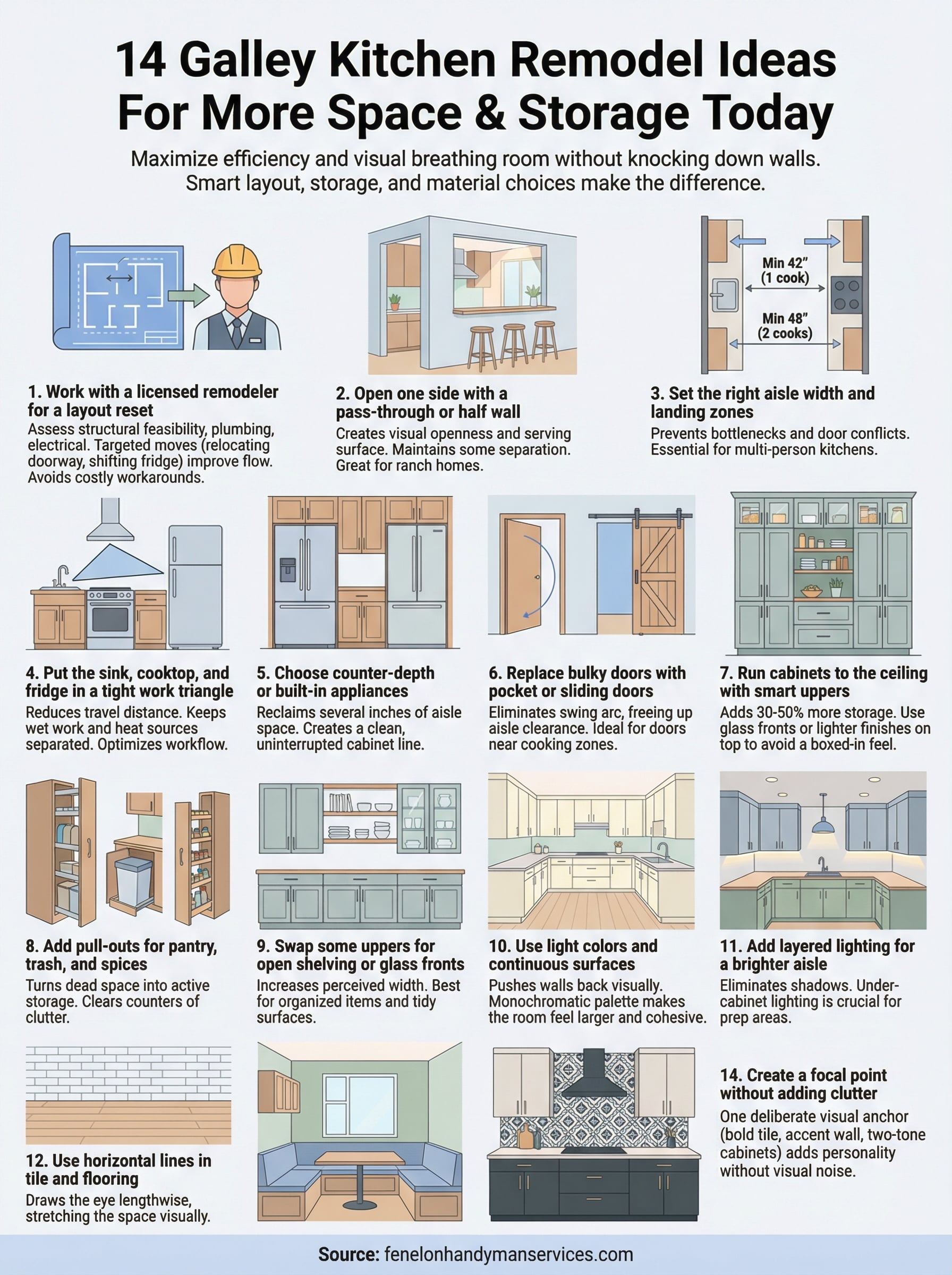
Ready to plan your galley remodel
You now have 14 proven galley kitchen remodel ideas that cover everything from layout resets and appliance choices to storage upgrades and finishing touches. The ones that matter most for your kitchen depend on your specific floor plan, budget, and how you actually use the space. Some of these changes you can tackle over a weekend; others require a licensed contractor who understands Tampa’s building codes and climate conditions.
If you’re ready to move from ideas to a real plan, Fenelon Handyman Services has been remodeling kitchens across the Tampa Bay area since 2014. We’ll assess your current layout, walk you through at least three solution options at different price points, and give you a transparent quote with no hidden costs. Contact our Tampa kitchen remodeling team to schedule your consultation and get your galley kitchen working the way it should.