
Cabinets take up more visual space in your kitchen than anything else. They also eat up the biggest chunk of your remodeling budget, often 40% to 50% of the total cost. So knowing how to choose kitchen cabinets that actually match your needs, your taste, and your wallet matters more than most people realize before they start shopping.
The problem is that cabinet shopping hits you with dozens of decisions at once. Framed or frameless? Solid wood or plywood box? Stock, semi-custom, or full custom? Shaker doors or flat-panel? Each choice affects how your kitchen looks, how long the cabinets last, and what you’ll end up spending. Without a clear framework, it’s easy to overpay for features you don’t need, or cut corners in places that cost you later.
At Fenelon Handyman Services, we’ve been installing and remodeling kitchens across the Tampa area since 2014. We’ve seen what holds up in Florida’s humidity and what starts warping within a year. This guide breaks down everything you need to know, from cabinet construction and materials to style, color, and hardware, so you can walk into a showroom or sit down with your contractor and make decisions with confidence.
What to decide before you shop
Before you get deep into figuring out how to choose kitchen cabinets, you need to answer three questions that will shape every decision that follows: how you use your kitchen, how long you plan to stay in your home, and who is going to install the cabinets. Skipping these questions leads to buyers picking cabinets based on what looks good in a showroom rather than what actually works in their daily life. A few minutes of honest thinking up front saves you from expensive regrets later.
Know how you actually use your kitchen
Your cooking habits directly determine the storage features and cabinet count you need. If you cook from scratch most nights, you need deep drawers for pots, pull-out shelves for dry goods, and more linear feet of lower cabinet space. If you mostly reheat and order in, you can get away with less and redirect your budget toward finishes or appliances. Walk through your current kitchen and note what you constantly search for, what never has a home, and where you run out of counter space. That friction tells you exactly what your new layout needs to solve.
The goal isn’t a kitchen that looks like a magazine photo. The goal is a kitchen that fits the way you actually live.
Think also about who else shares the kitchen with you. Families with young children benefit from lower cabinets with soft-close hinges and no sharp hardware edges. If someone in your household uses a wheelchair or has limited reach, standard 84-inch upper cabinets may not work, and you’ll want to plan lower uppers or open shelving in key zones.
Consider your home’s style and resale plans
Cabinets need to match the overall architectural character of your home, not just the kitchen itself. A sleek flat-panel cabinet in a dark stain looks right in a modern build but feels out of place in a 1970s ranch with traditional trim throughout. Walk from your front door to your kitchen before you commit to any style direction. The transition between rooms should feel intentional, not jarring.
Your resale timeline also changes how much you should spend and on what. If you plan to sell in the next three to five years, neutral colors and classic door styles like Shaker return more value than trendy finishes that may feel dated by the time you list the home. If you’re staying for 15 years or more, personal preference carries more weight than market trends.
Decide who handles installation before you buy
Cabinet type and installation method are directly connected. Stock cabinets from a big-box store ship in fixed sizes and work fine if your kitchen has standard dimensions and square walls. Semi-custom and custom cabinets require professional measurement and installation to get right. Knowing whether you’re hiring a contractor or managing the project yourself affects which cabinet lines are even practical for your situation, and it locks in a realistic total budget from the start.
Step 1. Measure your kitchen and map the layout
Accurate measurements are the foundation of how to choose kitchen cabinets that actually fit your space. Most ordering mistakes, gaps, or filler strips that look sloppy come from incorrect measurements taken at the planning stage. Before you look at a single cabinet door style, pull out a tape measure and get the real numbers for your kitchen.
What to measure and how
Measure every wall where cabinets will go, floor to ceiling and corner to corner. You need three measurements for each wall: at the floor, at mid-height, and near the ceiling. Walls in older homes are rarely perfectly plumb or square, and using only one measurement can throw off your entire layout. Record the location and width of every window, door, and appliance opening, including the space above the refrigerator.
A difference of even half an inch between your floor measurement and your ceiling measurement tells you there’s a slope you need to plan around before you order.
Use the table below to organize your measurements before you share them with a cabinet supplier or contractor:
| Wall | Floor Width | Mid-Height Width | Ceiling Width | Ceiling Height | Notes |
|---|---|---|---|---|---|
| Wall A | Window at ___" | ||||
| Wall B | Door at ___" | ||||
| Wall C | Range hood location | ||||
| Wall D | Refrigerator depth |
Map cabinet zones before you order
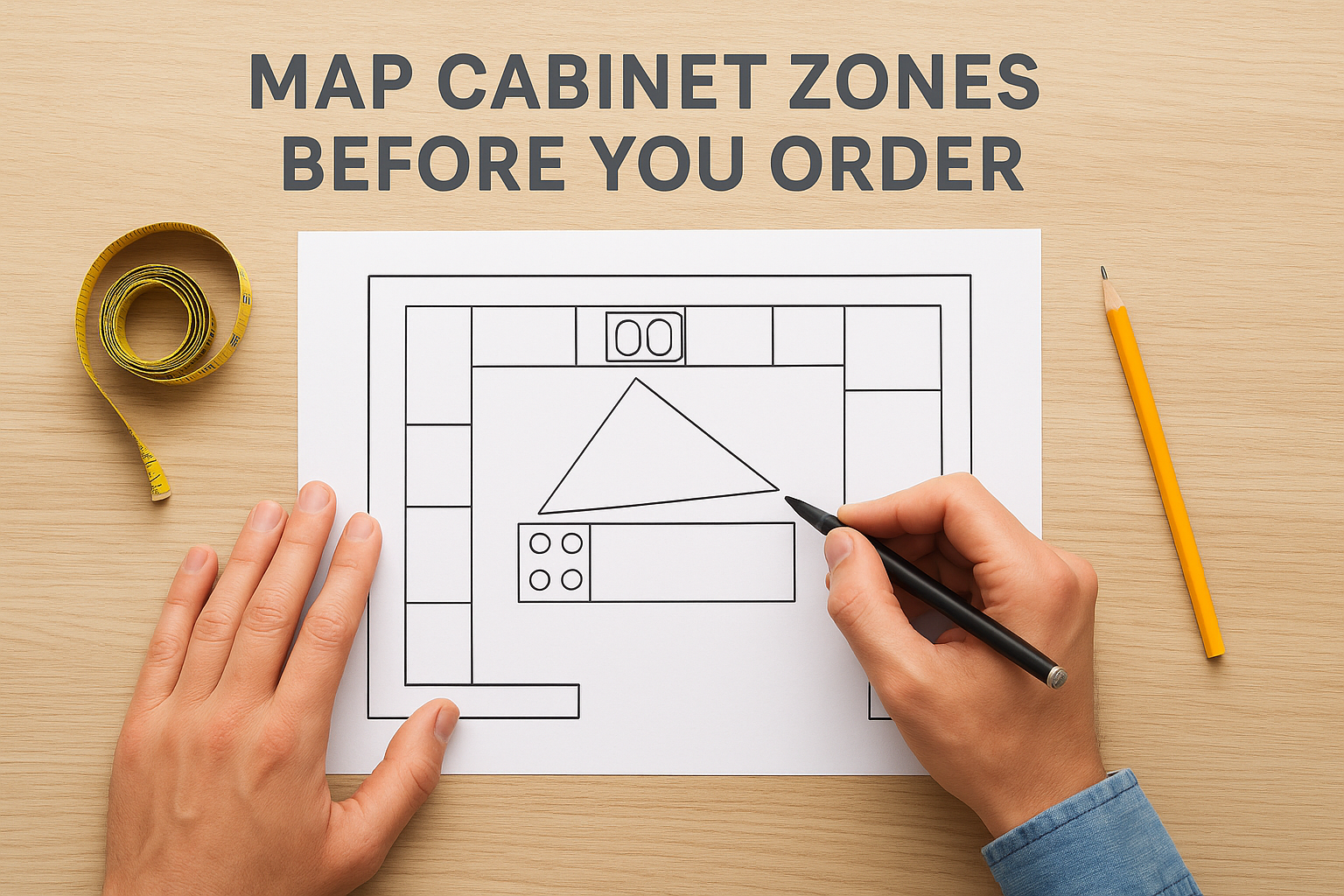
Once you have your numbers, sketch a simple top-down floor plan showing where uppers, lowers, and any island or peninsula will sit. Mark the work triangle, the path between your sink, range, and refrigerator, because cabinets that interrupt this path create daily frustration. Standard lower cabinets run 34.5 inches tall and upper cabinets typically start 18 inches above the counter, but your ceiling height determines how much room you have for stacked uppers or crown molding. Getting this layout confirmed before you order prevents costly returns and mid-project surprises.
Step 2. Choose cabinet type and customization level
There are three tiers of cabinets available, and each one represents a different trade-off between cost, flexibility, and lead time. Knowing which tier fits your kitchen is one of the most practical steps in how to choose kitchen cabinets, because it immediately narrows your options and sets a realistic budget range before you start comparing door styles or finishes.
Stock cabinets
Stock cabinets are pre-built in fixed sizes, typically in 3-inch increments, and sold directly off the shelf at home improvement stores. They cost the least and arrive the fastest, often within days. The trade-off is limited size variation, which means you may need filler strips to close gaps between cabinets and walls. Stock cabinets work well in standard rectangular kitchens where walls are square and dimensions fall within typical ranges.
If your kitchen has unusual angles, a chimney bump-out, or walls that are more than a quarter-inch out of square, stock cabinets will create fitting problems that cost time and money to work around.
Semi-custom and custom cabinets
Semi-custom cabinets come from a manufacturer but let you adjust dimensions, finishes, and interior features within a set range. They cost more than stock and typically take two to six weeks to arrive, but they fit more kitchens cleanly and offer a wider selection of door styles and wood species. Custom cabinets are built entirely to your specifications, with no size or finish restrictions, and they carry the highest price and longest lead time, sometimes eight to twelve weeks or more.
Use the table below to compare all three tiers side by side. Matching your kitchen’s layout to the right cabinet type early in the process prevents the most common and costly ordering mistakes that show up mid-installation.
| Type | Lead Time | Cost Level | Best For |
|---|---|---|---|
| Stock | Days | Low | Standard layouts, tight budgets |
| Semi-custom | 2 to 6 weeks | Medium | Most remodels needing a precise fit |
| Custom | 8 to 12+ weeks | High | Unique kitchens, specific requirements |
Step 3. Check cabinet construction and materials
Construction quality is where cabinets that look identical in a showroom start to differ sharply in how long they actually last. This step is one of the most important parts of how to choose kitchen cabinets, especially in a humid climate like Tampa where moisture and heat accelerate wear on lower-quality materials. Two cabinets can have the same door style and finish but carry completely different lifespans depending on what’s inside the box.
Box material: plywood vs. particleboard
The cabinet box, meaning the sides, bottom, back, and shelves, is where most of the structural difference lives. Plywood boxes resist moisture better, hold screws more securely, and flex without cracking under heavy loads. Particleboard boxes cost less and work fine in dry conditions, but they swell and degrade faster when exposed to steam near a dishwasher or under a sink. In Florida’s humidity, plywood boxes are worth the added cost.
If a cabinet line doesn’t specify plywood construction in its documentation, assume it’s particleboard and factor that into your decision.
Look also at the back panel thickness and how the box is assembled. Cabinets with a full-depth back panel, at least 3/8 inch, provide more rigidity than those with a thin back stapled in place. Dovetail or dowel-joined drawers hold up far longer than stapled ones.
Face frame vs. frameless construction
Face frame cabinets attach a solid wood frame to the front of the box, which adds rigidity and gives a traditional look. Frameless cabinets, common in modern European-style kitchens, skip the frame entirely and mount doors directly to the box, giving you slightly more interior access. Neither is universally better; the choice depends on the look you want and the door overlay style you plan to use, which we cover in the next step.
Check that hinge mounting plates are adjustable in at least three directions so installers can align doors precisely without shimming or forcing.
Step 4. Pick door style, overlay, and hardware
Door style, overlay, and hardware are the three visual decisions that define how your kitchen looks every single day. When you’re working through how to choose kitchen cabinets, these choices carry more weight than most people expect because they lock in the overall style direction of your kitchen and how well that direction holds up over time.
Door style
The two most common door styles are Shaker and flat-panel. Shaker doors feature a recessed center panel with a simple surrounding frame, and they work across traditional, transitional, and modern kitchens. Flat-panel, also called slab doors, use a single flat surface with no frame detail and read as cleaner and more contemporary. Raised-panel doors carry more decorative molding and suit traditional or colonial-style homes well.
Shaker is the safest choice for resale value because it reads as classic rather than trendy to most buyers.
Overlay type
Overlay describes how much of the face frame the door covers when it closes. Full overlay doors cover nearly the entire face frame, leaving only a small gap between adjacent doors. Partial overlay doors leave more of the face frame visible, which is common in traditional kitchens. Inset doors sit flush inside the face frame for a furniture-like look, but they require precise installation and cost significantly more because any settling or humidity shifts in the wood can cause binding.
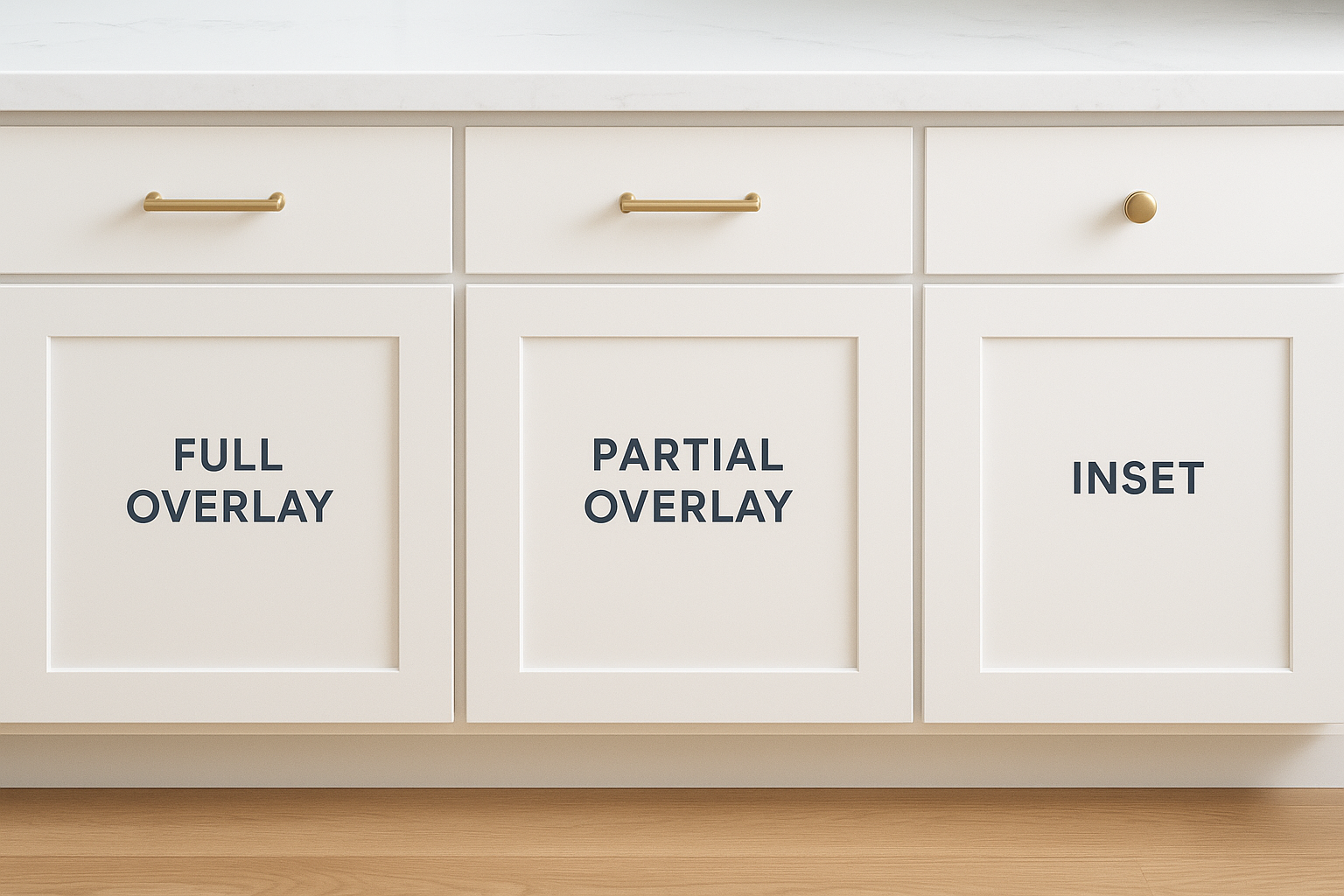
| Overlay Type | Look | Cost | Best For |
|---|---|---|---|
| Full overlay | Clean, minimal gaps | Medium | Modern, transitional |
| Partial overlay | Traditional frame visible | Low | Classic, budget builds |
| Inset | Flush, furniture-style | High | High-end traditional |
Hardware
Hardware is one element you can swap out later without replacing the cabinets, but choosing it thoughtfully up front keeps your kitchen looking cohesive from day one. Pulls work better than knobs on drawers because your whole hand engages the pull, reducing strain over repeated use. Stick to one metal finish throughout the kitchen and match it to your faucet and light fixtures for a unified result.
Step 5. Choose color and finish that hold up
Color and finish might feel like the fun part of how to choose kitchen cabinets, but they’re also where long-term durability gets overlooked most often. The finish on your cabinet doors takes daily contact from hands, steam, cleaning sprays, and in Florida specifically, elevated humidity that slowly degrades poorly sealed surfaces. Choosing a finish based on looks alone, without checking how it’s applied and what it’s designed to resist, leads to peeling, yellowing, or fading within a few years.
Painted vs. stained finish
Painted cabinets give you the widest range of color options and work in nearly any style direction, from crisp white to deep navy. A factory-applied painted finish, also called a catalyzed lacquer or conversion varnish, holds up far better than a site-painted cabinet because it cures under controlled conditions. Stained cabinets show the natural wood grain and tend to age more gracefully because small scratches and wear blend into the texture rather than showing as stark chips against a solid color.
If you’re buying painted cabinets, ask the manufacturer specifically whether the finish is catalyzed, because non-catalyzed paints scratch and yellow much faster in humid kitchens.
Colors that hold their value
Neutral tones, including white, off-white, soft gray, and warm greige, consistently outperform bold or trendy colors when it comes to long-term resale value and overall visual flexibility. Bold colors like deep green or two-tone combinations can look sharp, but they narrow your design options for countertops, backsplash, and flooring. If you want personality in your kitchen, add it through hardware and lighting rather than locking it into your cabinet finish.
Use the guide below to match your color choice to the right situation:
| Color Direction | Best Situation | Risk |
|---|---|---|
| White or off-white | Selling within 5 years | Shows dirt faster |
| Warm gray or greige | Long-term stay, neutral palette | Can feel flat without contrast |
| Navy or forest green | Staying 10+ years, modern style | Limits future update flexibility |
| Natural wood stain | Traditional or transitional homes | Harder to change later |
Step 6. Set a cabinet budget and plan installation
Budget is the final variable that pulls everything else together when you’re working through how to choose kitchen cabinets. Most people set a total kitchen remodel number without separating cabinet costs from installation costs, which leads to sticker shock when the labor quote arrives. Treat these as two separate line items from the start so you can make clear trade-offs without blowing your overall budget.
Break down cabinet costs by category
A realistic cabinet budget depends on your kitchen’s square footage and the tier of cabinet you choose. As a general starting point, stock cabinets for an average 10-by-12 kitchen typically run $2,000 to $5,000 for materials, semi-custom runs $5,000 to $15,000, and full custom can exceed $25,000. These numbers cover the boxes and doors only, not countertops, hardware, or installation.
Allocating 40% to 50% of your total remodel budget to cabinets is the standard industry range, and staying within it keeps your countertop, flooring, and appliance budgets intact.
Use the table below to map out your full cabinet spend before you finalize any order:
| Line Item | Estimated Cost | Notes |
|---|---|---|
| Cabinet boxes and doors | Varies by tier | Get quotes from at least two suppliers |
| Hardware (pulls, hinges) | $3 to $15 per piece | Budget per door and drawer count |
| Delivery and handling | $150 to $400 | Confirm if included in supplier quote |
| Professional installation | $75 to $150 per linear foot | Includes measuring, hanging, and leveling |
| Filler strips and trim | $200 to $600 | Required for most stock cabinet installs |
Plan your installation timing
Cabinet installation happens after rough plumbing and electrical work is complete but before countertops are templated or installed. If you’re coordinating multiple trades, confirm that your cabinet delivery date and your installer’s schedule align before you place the order. Delays between delivery and installation can expose unfinished cabinets to Tampa’s humidity, which warps wood and swells particleboard before a single door is hung.
Next steps for your kitchen plan
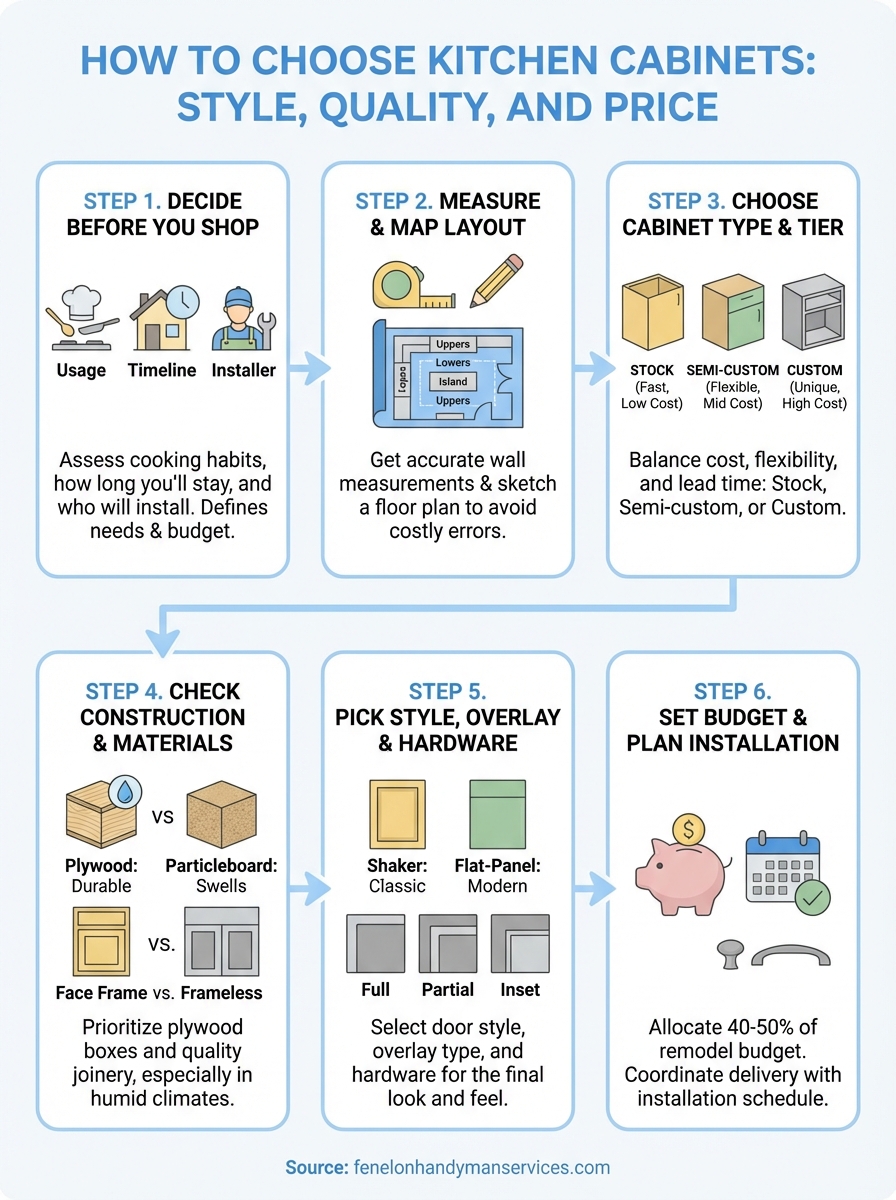
You now have a complete framework for how to choose kitchen cabinets that fit your space, your cooking habits, and your budget. Start by locking in your measurements and layout, then confirm your cabinet tier before you get into door styles and finishes. Each decision builds on the one before it, so skipping ahead creates gaps that turn into costly mistakes during installation or after delivery.
If you’re in the Tampa area and want a professional set of eyes on your kitchen before you commit to an order, the team at Fenelon Handyman Services can help. We’ve been handling kitchen remodeling in Tampa since 2014, and we give every customer at least three solution options at different price points so you can make the call that fits your situation and budget. Reach out today and we’ll walk through your kitchen with you before a single cabinet gets ordered.