
If you’re planning a flooring project in 2026, the first question on your mind is probably: what does flooring installation cost per square foot? It’s a fair question, and one without a single easy answer. The price swings dramatically depending on the material you choose, the condition of your subfloor, and where you live in the country. A tile job in Tampa doesn’t cost the same as one in Minneapolis.
At Fenelon Handyman Services, we install and repair laminate, hardwood, tile, vinyl, and carpet across the Tampa–St. Petersburg metro area. We quote flooring projects every week, and we see firsthand how confusing pricing can be for homeowners who are trying to compare estimates. One contractor’s quote covers materials and labor bundled together. Another breaks it out line by line but tacks on fees at the end. Neither approach helps you if you don’t know what a reasonable per-square-foot range looks like in the first place.
That’s what this article is for. Below, we break down the average material and labor costs per square foot for the most common flooring types installed in homes right now, hardwood, laminate, luxury vinyl plank, tile, and carpet. We’ll cover what drives prices up, what keeps them down, and how to read a flooring estimate so you can make an informed decision before signing anything.
Why cost per square foot matters
When a contractor hands you a total project price, it’s almost impossible to know if that number is fair without a baseline to compare it against. A $4,500 flooring bid could be a great deal for 800 square feet of hardwood or a serious overcharge for 600 square feet of laminate. Flooring installation cost per square foot is the unit of measurement that lets you compare materials, labor rates, and contractor quotes side by side, on equal terms, without guessing.
It’s the only fair way to compare quotes
Every flooring estimate you receive will be structured differently. One contractor might quote you $6 per square foot for materials and $4 for labor, listed separately on the invoice. Another might hand you a single bundled number with nothing broken out. A third might include subfloor prep in their rate while a fourth charges it as a separate line item. Without knowing the per-square-foot breakdown for each component, you’re comparing numbers that don’t actually represent the same scope of work.
When you ask every contractor to quote the same job using cost per square foot, the differences in their pricing become immediately obvious.
Requesting itemized per-square-foot costs for materials, labor, and any additional fees gives you a consistent framework for comparison. This matters especially when you’re collecting three or four bids, because even small differences in rate add up quickly across a large floor. A contractor who charges $1.50 more per square foot than a competitor can look cheaper on paper if they’ve buried removal or prep costs elsewhere in the estimate.
The price you see advertised isn’t what you actually pay
Home improvement stores and flooring manufacturers often advertise material-only prices that look attractive on a shelf tag or a promotional flyer. You’ll see vinyl plank listed at $1.99 per square foot or ceramic tile at $2.49, and those numbers are accurate, but they represent only one layer of the total cost. By the time you add professional installation labor, underlayment, transition strips, adhesive, and removal of your existing floor, your real cost per square foot can run two to four times higher than the sticker price you saw first.
Planning your budget around material costs alone leads to shortfalls that aren’t easy to recover from mid-project. A homeowner who estimates a $3,000 job based on advertised material prices may receive quotes starting at $6,500 or more once labor and prep are included. Understanding the full per-square-foot picture before you start requesting bids keeps that gap from catching you off guard when the estimates arrive.
Room size multiplies every dollar difference
This is where per-square-foot pricing has the most direct impact on your final bill. A $1 difference per square foot sounds minor on its own, but across a 1,200 square foot open-plan living space, that single dollar represents $1,200 in what you actually write a check for. Choosing between two materials priced $3 apart per square foot creates a $3,600 swing on the same room, which is real money regardless of your budget.
Tampa homes frequently feature large, connected living areas that push total square footage well beyond what most homeowners estimate at first glance. When you add hallways, closets, and rooms with irregular or angled shapes, the numbers climb faster than expected. Measure each room carefully, add 10 percent for waste and cuts, and then apply the per-square-foot ranges covered in the next section to build a realistic budget before you make any calls.
2026 cost ranges by flooring type
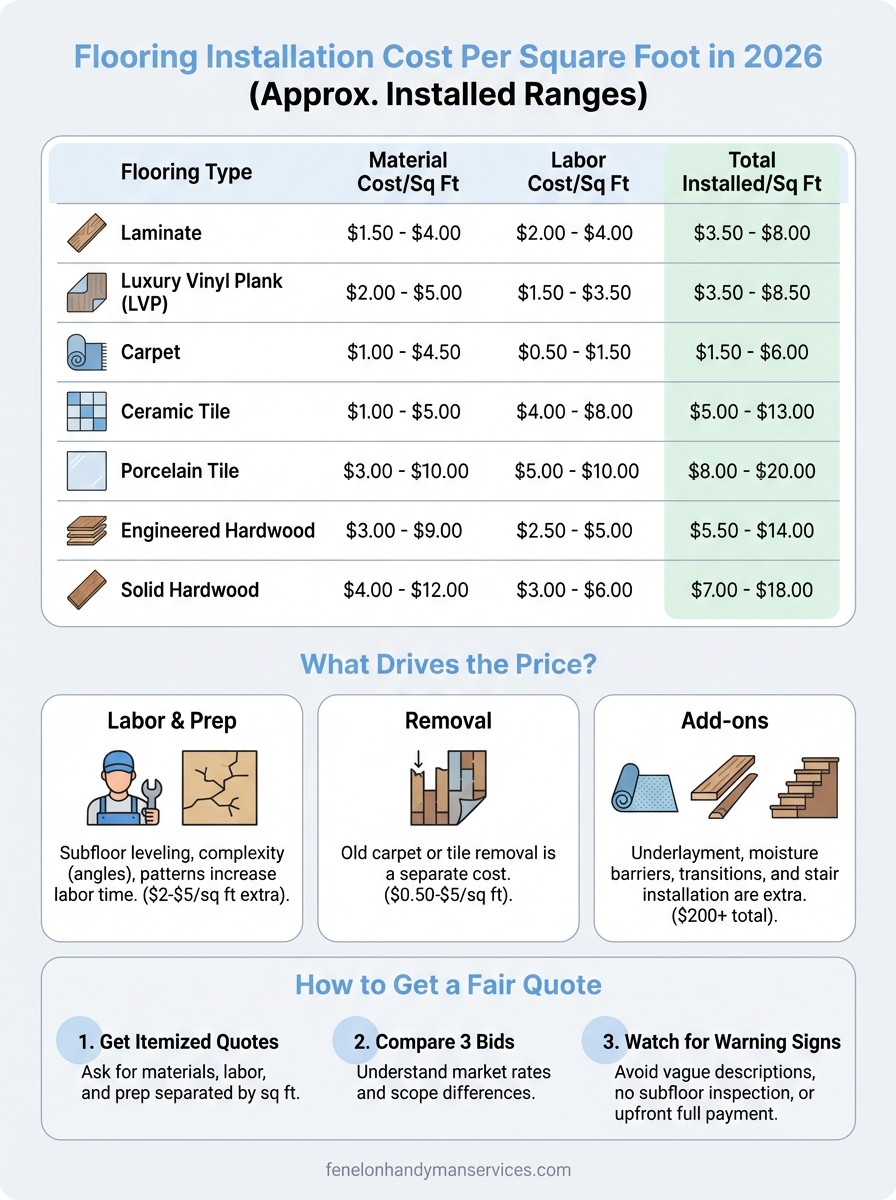
The ranges below reflect installed prices covering both materials and labor based on typical residential projects in 2026. Flooring installation cost per square foot varies by material grade, regional labor rates, and job complexity, so treat these figures as planning benchmarks rather than fixed quotes. Tampa’s labor market runs close to national averages, which makes them a reliable starting point for your budget.
| Flooring Type | Material Cost/Sq Ft | Labor Cost/Sq Ft | Total Installed/Sq Ft |
|---|---|---|---|
| Laminate | $1.50 – $4.00 | $2.00 – $4.00 | $3.50 – $8.00 |
| Luxury Vinyl Plank (LVP) | $2.00 – $5.00 | $1.50 – $3.50 | $3.50 – $8.50 |
| Carpet | $1.00 – $4.50 | $0.50 – $1.50 | $1.50 – $6.00 |
| Ceramic Tile | $1.00 – $5.00 | $4.00 – $8.00 | $5.00 – $13.00 |
| Porcelain Tile | $3.00 – $10.00 | $5.00 – $10.00 | $8.00 – $20.00 |
| Engineered Hardwood | $3.00 – $9.00 | $2.50 – $5.00 | $5.50 – $14.00 |
| Solid Hardwood | $4.00 – $12.00 | $3.00 – $6.00 | $7.00 – $18.00 |
Budget and mid-range options
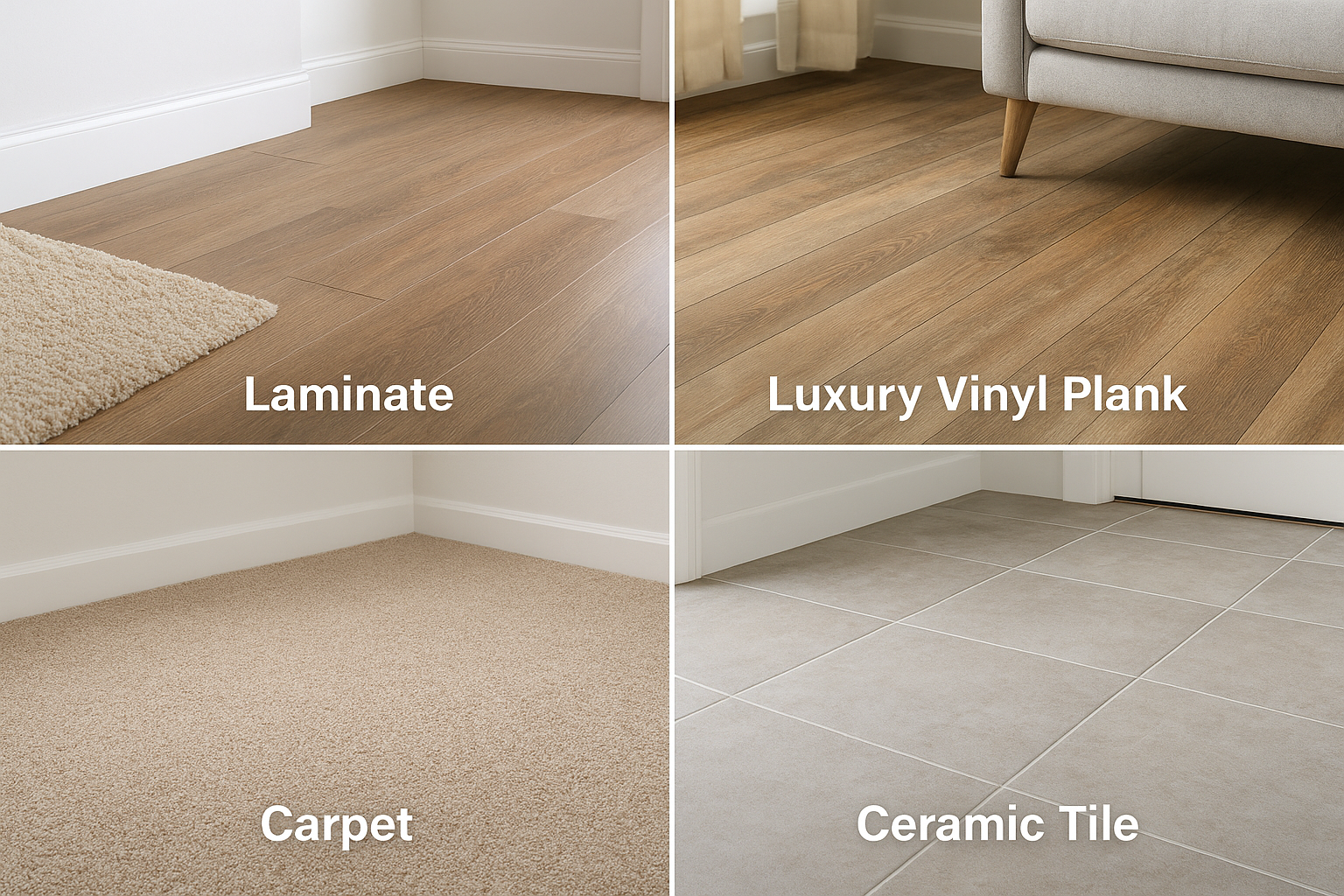
Laminate and luxury vinyl plank occupy the most competitive part of the market right now. LVP has become the dominant choice for Tampa homeowners because it handles humidity well, installs quickly, and lands in the $3.50 to $8.50 per square foot installed range. Laminate runs similarly but tolerates moisture less effectively, which matters in Florida bathrooms and laundry rooms.
If you’re working with a tight budget across a large area, LVP gives you the best combination of durability, moisture resistance, and installed cost for most rooms in a Florida home.
Carpet remains the most affordable installed option available. Basic carpet with labor can come in as low as $1.50 per square foot, but mid-grade carpet with quality padding starts closer to $4.00. For high-traffic areas, the mid-grade option holds up better and typically costs less over time when you factor in replacement cycles.
Premium flooring options
Solid hardwood and porcelain tile sit at the top of the price range for good reasons. Solid hardwood typically runs $7.00 to $18.00 per square foot installed, with wide-plank or exotic species pushing toward the upper end. Engineered hardwood delivers a similar appearance at a lower cost and performs better in humid climates, making it a practical choice for Florida rooms.
Porcelain tile can reach $20.00 per square foot on large-format or patterned installations where the labor time increases substantially. Ceramic tile is more accessible on materials, but its higher installation labor still puts most completed jobs above $5.00 per square foot. Both tile options require a solid, level subfloor, which can add to your prep costs before a single tile goes down.
Labor, prep work, and removal costs
The material price tag on a flooring product tells only part of the story. Labor, subfloor preparation, and old floor removal are separate cost layers that can add $2.00 to $5.00 per square foot on top of what you pay for materials. Understanding each component on its own helps you spot whether a contractor’s quote is complete or whether it’s missing pieces that will show up as change orders after the work begins.
What drives labor rates
Flooring labor rates vary based on the material being installed and the complexity of the job. Carpet installation runs on the low end because it moves quickly with minimal cuts in open rooms. Tile work sits at the high end because the installer must mix and spread mortar, maintain consistent spacing, and grout every joint after the tile cures. LVP and laminate fall in the middle, with most installers charging between $1.50 and $4.00 per square foot for a straightforward floating floor in a rectangular room.
Ask each contractor to walk you through exactly what their labor rate includes before you accept any quote.
Angled walls, curved layouts, and intricate patterns all push labor costs higher because they increase cut time and material waste. A herringbone tile pattern requires significantly more installer time than a standard grid in the same room, even with identical materials. When you compare flooring installation cost per square foot across bids, always confirm whether the labor rate reflects your specific room layout and pattern choice.
Subfloor preparation
Your subfloor condition directly affects what you pay before installation begins. A level, dry, and structurally sound subfloor costs nothing extra to prep. But if your subfloor has soft spots, moisture damage, or significant unevenness, the installer needs to address those issues first. Leveling compound typically adds $1.00 to $3.00 per square foot depending on how much product the job requires.
Tampa homes face higher rates of subfloor moisture damage than homes in drier climates because of persistent humidity and occasional storm flooding. Always ask a contractor to inspect your subfloor before you finalize your project budget, not after demo starts.
Old flooring removal
Removing your existing floor is a separate line item on most quotes. Carpet removal runs $0.50 to $1.50 per square foot, while tile removal costs considerably more because breaking up and hauling away ceramic or porcelain is physically demanding work. Tile removal typically reaches $3.00 to $5.00 per square foot depending on thickness and adhesive type.
Some homeowners pull up old carpet themselves to reduce their quote, which is a practical option on most residential jobs. Tile removal, however, requires proper tools and a disposal plan, so leaving that task to the contractor generally makes more sense than attempting it on your own.
Add-ons that change the final price
Once you have a baseline understanding of material and labor costs, several additional line items can push the final flooring installation cost per square foot higher than your initial estimate. These charges are legitimate and often necessary, but they’re easy to miss if you don’t know to ask about them upfront. Reviewing each add-on separately before signing a contract helps you avoid surprises when the final invoice arrives.
Underlayment and moisture barriers
Most floating floors require an underlayment layer between the flooring product and the subfloor. Underlayment adds cushion, reduces sound transmission, and provides a slight thermal barrier, and its cost varies depending on the type your installation requires. Basic foam underlayment runs $0.25 to $0.50 per square foot, while premium options with built-in moisture barriers can reach $0.75 to $1.50 per square foot.
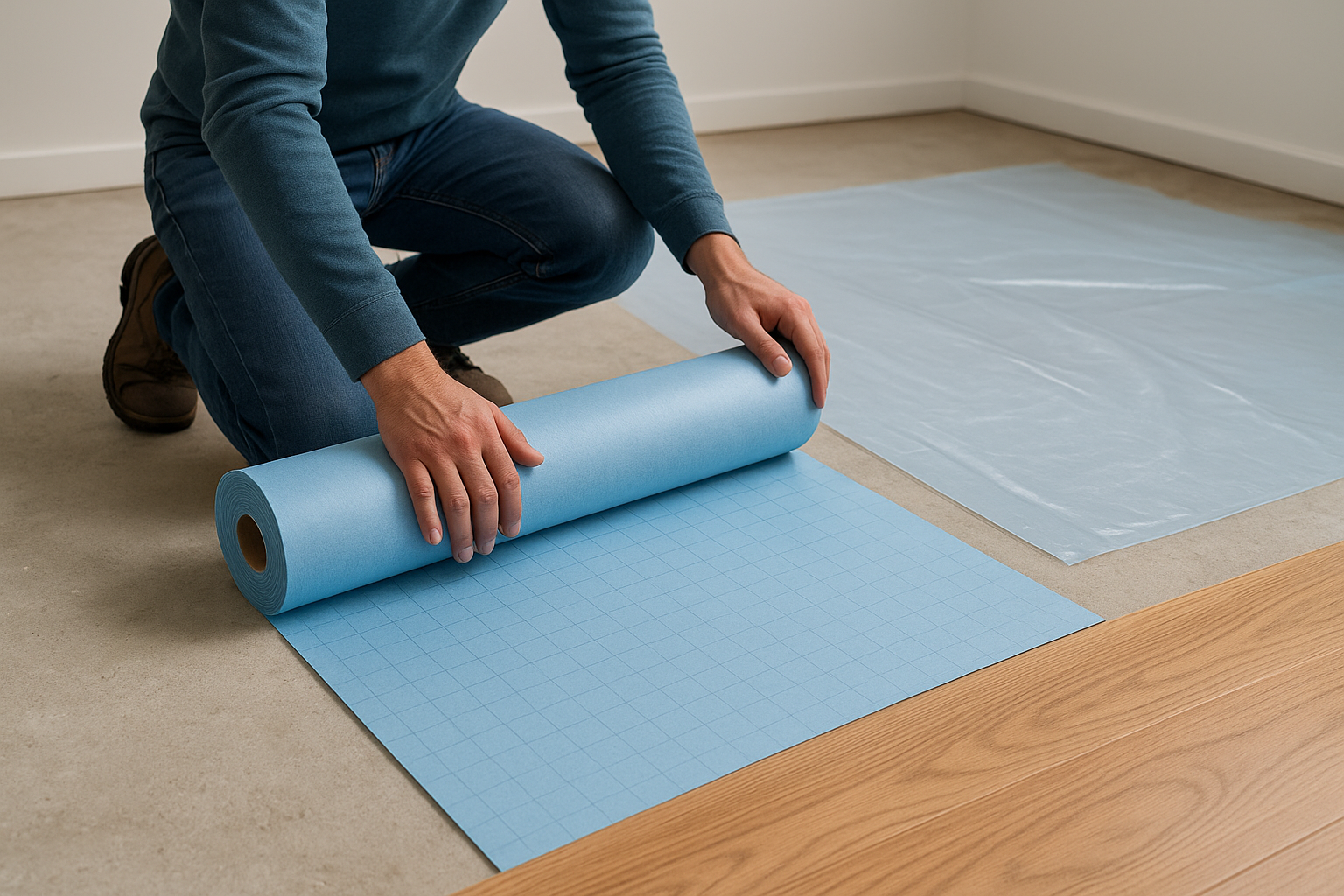
In Tampa specifically, moisture barriers are not optional on concrete slab subfloors. High ambient humidity and seasonal rain create conditions where moisture migrates upward through concrete and damages flooring from below if no barrier is present. Confirm with your contractor whether the underlayment they’ve included in the quote is appropriate for your subfloor type before work begins.
Skipping a moisture barrier on a concrete slab in Florida to save a few dollars per square foot will likely cost you a full floor replacement within a few years.
Transitions, trim, and finishing materials
Transitions are the small strips that bridge two different flooring materials or cover the gap at a doorway, and they’re easy to forget until the crew reaches the last room. Transition strips typically cost $2.00 to $8.00 per linear foot installed, depending on the material and profile style. Base molding and quarter-round trim add similar per-foot costs to finish the perimeter of each room cleanly.
These finishing materials are usually not included in a per-square-foot labor rate unless the contractor specifies otherwise. A project with multiple doorways, open transitions, and extensive baseboard work can add several hundred dollars to the total once trim is accounted for.
Stair installation and odd-shaped rooms
Stairs require considerably more labor than open floor areas because each tread and riser must be measured, cut, and secured individually. Most contractors price stair work by the step rather than by the square foot, with rates typically ranging from $25 to $75 per step depending on material and nose profile. Rooms with bay windows, angles, or curved walls also push labor hours up beyond what a standard rectangular room requires at the same floor type.
How to estimate and vet contractor quotes
Before you contact a single contractor, do your own rough estimate. Measure each room in square feet, add the totals, then apply a 10 percent overage for cuts and waste. Take that number and multiply it against the installed cost ranges for your chosen material. This gives you a realistic budget anchor so you know immediately whether a quote is in the right ballpark or wildly off before you spend time meeting with someone.
Ask for a fully itemized breakdown
When you request quotes, tell each contractor upfront that you want materials, labor, removal, and prep listed as separate line items with a per-square-foot rate for each. Most professional contractors have no issue providing this. The ones who push back or only offer a single bundled number make it impossible to compare their flooring installation cost per square foot against competing bids fairly. An itemized quote also protects you later because it defines exactly what’s included in the agreed price.
If a contractor refuses to break out their pricing by line item, that alone is reason enough to move on to the next bid.
Compare three quotes minimum
Getting three quotes on the same scope of work is not about finding the cheapest option. It’s about understanding what the market actually charges for the work you need done in your area. If two quotes come in within 15 percent of each other and a third is dramatically lower, that gap usually signals a difference in scope, not a bargain. Ask the outlier contractor what they’re excluding to arrive at that number.
Watch for these warning signs
Some quotes look reasonable on the surface but carry conditions that can increase your final cost significantly. Before you sign anything, scan for these specific issues:
- No subfloor inspection mentioned before installation begins
- Removal and disposal listed as "not included" with no separate price provided
- Vague descriptions like "flooring installation" with no material specs attached
- Payment in full required upfront before any work starts
- No written warranty on labor separate from the product manufacturer’s warranty
A reputable contractor will price the job completely, inspect conditions before committing to a final number, and put all terms in writing. If the quote you’re reviewing has multiple items from the list above, request a revised document before moving forward.
Next steps for planning your flooring install
You now have everything you need to build a realistic budget before a single contractor visits your home. Start by measuring your rooms, applying the flooring installation cost per square foot ranges in this article, and writing down a target number for materials, labor, removal, and prep separately. That preparation alone puts you ahead of most homeowners who request quotes with no baseline in mind.
From there, collect at least three fully itemized bids from licensed, insured contractors and compare each one line by line using the framework covered above. Watch for missing scope items, vague descriptions, and any quote that skips a subfloor inspection. If you’re located in the Tampa area and want a straightforward quote with no hidden fees and clear pricing options, contact Fenelon Handyman Services to schedule an estimate for your flooring project.